Eino Kolli – a man of his word, a Karelian evacuee
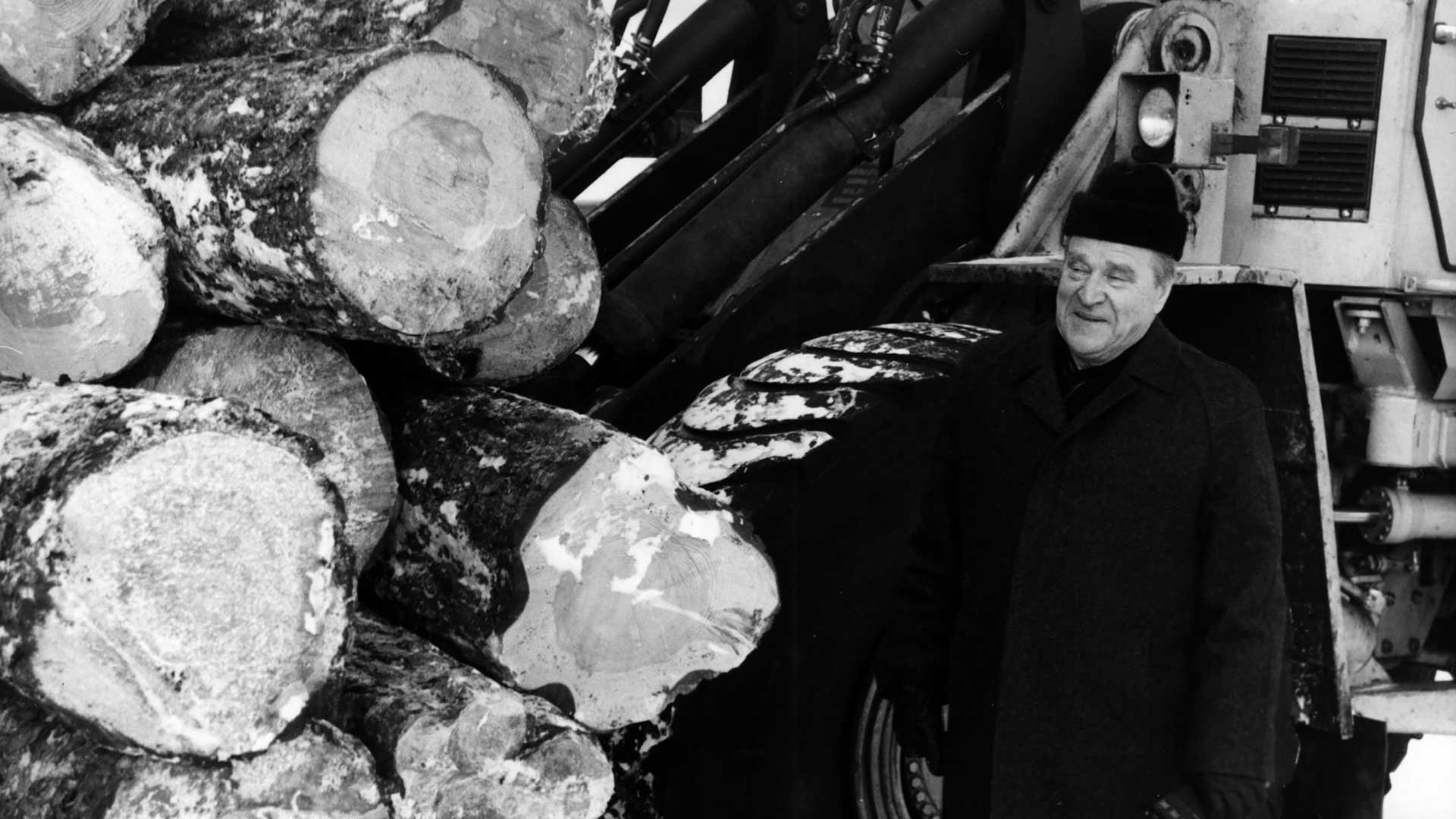
Eino Kolli (14.11.1925 – 17.7.2016) was born in the village of Alapuusti in Käkisalmi rural municipality on the Kolli farm, the youngest of five children in a farming family. The homestead had belonged to the Kolli family since at least 1687. Eino's parents, Tuomas and Kaisa Kolli, had married in 1912. Eino had two sisters, Jenny and Lahja, and two brothers, Viljo and Väinö. Tuomas Kolli's mother, Liisa, also lived on the farm.
Like his siblings, Eino Kolli worked on the farm from childhood. He started primary school in the autumn of 1932, and in the same year he also began work as a herdsman. Six-year-old Eino's task was to drive the cows three kilometres to pasture. Plougihng work also became familiar at a young age. The Kolli farm received several awards at agricultural exhibitions. There was a staff of as many as 15 people.
The village farms also had common meadows, which were cleared together, and the crop varieties were agreed upon together.

To the war and to Vierumäki
When the Winter War broke out, Eino Kolli stayed behind to look after the family farm and its livestock. Evacuation to Isokyrö in Southern Ostrobothnia took place in March 1940. The Kollis returned to Käkisalmi in December 1941. Eino's work on the home farm continued until October 1943, when he entered military service. He served in the Ladoga Coastal Artillery until May 1944 and in the Ladoga Coastal Brigade until November 1944. After that, he served in the Lapland War with the Naval Battalion until 26 April 1945.
After the Continuation War, the Kollis moved to Vierumäki in the rural municipality of Heinola. In 1946, they acquired the 70-hectare Ylä-Syrjälä estate in the village of Härkälä and began producing feed for dairy and beef cattle. Eino Kolli was no longer tempted by the stony fields of East Häme for ploughing, so he ended up in the forestry sector.
Kolli worked for the State Fuel Office (VAPO) from 1945 to 1947 and for the Kymi Timber Floating Association in 1948. He began his studies at Evo Forestry College in 1949, graduating as a forestry technician in 1950. The large trees of Evo had made an impression on him during his studies, and Kolli later became known for his trade in timber poles.

Eino Kolli sold his products directly to international markets and made the Finnish wood-processing industry known.
Timber trade and entrepreneurship
After forestry college, Kolli started in the timber trade. In 1950, he supplied sawn timber for ships being built as war reparations and became an important supplier to the shipbuilding industry. He also traded firewood and gained valuable experience in export by exporting poles and railway sleepers to England, Poland and Ireland. Kolli bought the sawn timber from sawmills.
In 1946, roadmaster Mauno Länsipuro and lorry driver Viljam Partanen had founded a sawmill in the village of Härkälä in Vierumäki, in the rural municipality of Heinola. The company was named Vierumäen Teollisuus Oy. In 1953, Eino Kolli bought Länsipuro's shares in the company, and the following year, Partanen's.
The sawmill was modest. There was one frame saw and lighting was handled by gas lamps. Work was sometimes done in bleak conditions, but Kolli paid the workers better wages than other sawmills. Soon Kolli had electricity brought to the sawmill, acquired two frame saws and built a planing line.
When demand in the shipbuilding industry began to wane, the Vierumäki sawmill started looking for speciality products and focusing on product quality, exports and delivery reliability. Kolli was interested in the versatile use of wood and the development of processing. This brought opportunities for export growth.
On the 13th of June 1954, a fire destroyed the sawmill. Kolli quickly had plans ready for a new sawmill, and the new plant started at the beginning of 1955. It was equipped with four frame saws, a kiln, a debarking machine and chipping equipment. In the artificial pond, the logs stayed clean and unfrozen. Modern machinery improved competitiveness. With the new sawmill, the number of employees rose from under ten to nearly 50, and by the end of the 1950s to already a hundred.
Kolli demanded absolute adherence to schedules and listened attentively to the needs of customers. He supervised the sawmill's operations closely. Kolli's commitment to the sawmill is illustrated by the fact that he built a home for his family on the sawmill site. In his home office, he managed the company's affairs.
The sawmill industry has traditionally been very sensitive to economic cycles. Banks monitored the operations of sawmills closely, and Vierumäki Teollisuus had its long-term credit called in in 1957. The bank stated its reasons as doubts over profitability – Kolli had paid higher prices for raw timber than others. Kolli's sawmill was located on dry land, meaning timber could not be floated there, and the bank considered this a disadvantage too. Kolli paid off his loan and changed banks. Afterwards, he operated with a greater degree of self-sufficiency than before.
Saha began to focus on pole timber and bought pole-heavy stands, paid well for them, and built long-term customer relationships. In the fiercely competitive timber trade, Vierumäen Teollisuus retained the advantage of buying stands dominated by special timber. Kolli broke away from the agreements and purchasing cartels of the forest industry and forestry owners, and started out as an independent buyer of roundwood.
Increased production required more space. When Kolli bought the company, the site was two hectares in size. It expanded first to 24, then to 42, and finally to over a hundred hectares.
In the 1960s, Vierumäen Teollisuus employed around one hundred people at its sawmill and approximately 300 in the forests. The company's significance in Vierumäki was substantial, partly thanks to its active housing policy. The company acquired land for residential areas, housing shares for rental properties, and had terraced and apartment blocks built for its employees not only in Vierumäki but also in Heinola. For the construction of detached houses, the company provided its staff with timber and machinery at cost price.

Neither temporary layoffs nor redundancies
The company neither laid off nor dismissed any employees. During the economic downturn, employees were provided with work in, among other things, the construction of production facilities and residential housing. In-house construction was utilised when developing the use of timber.
Vierumäki Industry was implementing local agreements even before it was a common topic of discussion. Kolli agreed on terms better than the collective agreements with the chief shop stewards. Indeed, the company was known for never having strikes.
Kolli developed his company through customer focus, further processing, renewing machinery and improving productivity. The sawmill was the first in Finland to introduce the production of finger-jointed sawn timber in 1966 and specialised in producing cut-to-length timber, impregnated poles, construction elements and glulam beams.
In 1967, the sawmill caught fire again. The fire destroyed the power station, the four-frame sawmill building, as well as a kiln full of sawn timber and the filing room with its machinery.
To the largest of the medium-sized
In the 1960s, Vierumäen Teollisuus grew into the largest of the medium-sized sawmills in Finland. One of the products of their product development was a fodder silo, which could be used for both storing silage and as a slurry tank. With the silos came the need to improve the durability of the wood, and a salt-impregnation plant began operations in the mid-1960s.
Poles were an important product for Vierumäen Teollisuus. Over half of the production went to export and the company was among Finland's hundred largest exporting companies.
The early 1970s was an economic downturn. Vierumäki Teollisuus' position was improved by its diverse production, product development and new methods of further processing. During the decade, turnover quadrupled. Exports expanded to over 20 countries and the Mediterranean region in particular became important. Vierumäki Teollisuus became the largest industrial employer in the rural municipality of Heinola.
The manufacture of glulam beams began in 1976. The company also developed a manufacturing technique for prestressed glulam bridges. In 1977, a new roof structure that combined glulam with steel cables and rods was introduced into production. The development of impregnation techniques was a key factor in the business, and Vierumäen Teollisuus became Europe's largest impregnation plant.
Over three decades, the company grew from a small sawmill into a significant export enterprise. The reasons for this growth were skilful timber procurement, successful investments, further processing, continuous product development and also good management. The company was a sought-after place to work and survived difficult years thanks to its long-term operations. An important decision had been that the company did not take out foreign currency loans.
Product development was continued in the late 1980s by establishing a multi-product factory to manufacture various elements, custom-sized sawn timber, planed products and glued laminated timber. The new factory was able to serve customers more flexibly than before.
In 1983 Eino Kolli was awarded the honorary title of industrial counsellor.
Renunciation
Eino Kolli began preparing to divest the company in the late 1980s, when no successor for the business could be found within the Kolli family and relatives. At the beginning of 1990, Vierumäen Teollisuus got new owners when Keijo and Tenho Kopra bought the company. They were Karelian sawmill entrepreneurs by background from Juupajoki. Kolli wanted to sell the sawmill to a private entrepreneur who would be able to maintain the good spirit of the work community and take care of the staff and customer relations.
Kolli had hoped that the positions of the old employees would be secured, but the new owners acted differently. The deep recession that began in the autumn of 1991 contributed in part to the changes. In 2004, the Kopra family changed the company name to Versowood Oy.
Foundation
Eino Kolli continued his work at Kolli Invest Oy, a securities trading company established in 1991, and at the Marjatta and Eino Kolli Foundation, which was founded in 1992 and commenced operations the following year.
The foundation specifically supports research and development related to agriculture, forestry and construction, with a particular emphasis on activities that have a positive long-term impact on the living environment. It awards grants for scientific and applied research and development.
The foundation has invested a large part of its capital in real estate in Lahti and Heinola. In addition, the foundation owns 2,000 hectares of forest.
In 2005, the Eino Kolli Special Fund was established within the Finnish Foundation for Economic Education. It supports projects that promote entrepreneurship.
Käkisalmi and Karelia
Karelianism was important to Eino Kolli throughout his life. He was happy to tell stories about Karelia.
Family and siblings were important to Eino Kolli, and he regularly organised parties on his birthday and Independence Day. All the siblings with their families took part in them.
He visited his former home place in Käkisalmi a few times after the border opened, the first time on a family trip in 1991. The trip included a visit to the Kolli family home, among other places. Although the visit was emotional, the grief over losing his home region had already been processed earlier.
Karelian background was also evident in a love for animals and nature. Eino Kolli had dogs and cats. In a pond dug in the sawmill area, there were ducks, which Kolli would go to feed. Sometimes there were also sheep in the area, for which a movable fence was made. Kolli also experimented with cultivating false morels in the factory area.
Kolli was actively involved for decades in the Käkisalmi Foundation, formerly known as the Käki Foundation. He was a board member from 1963 to 1976, chairman from 1976 to 1992, and honorary chairman from 1994 to 2016.

