The tribal chief known from the market square – Veikko Mykrä
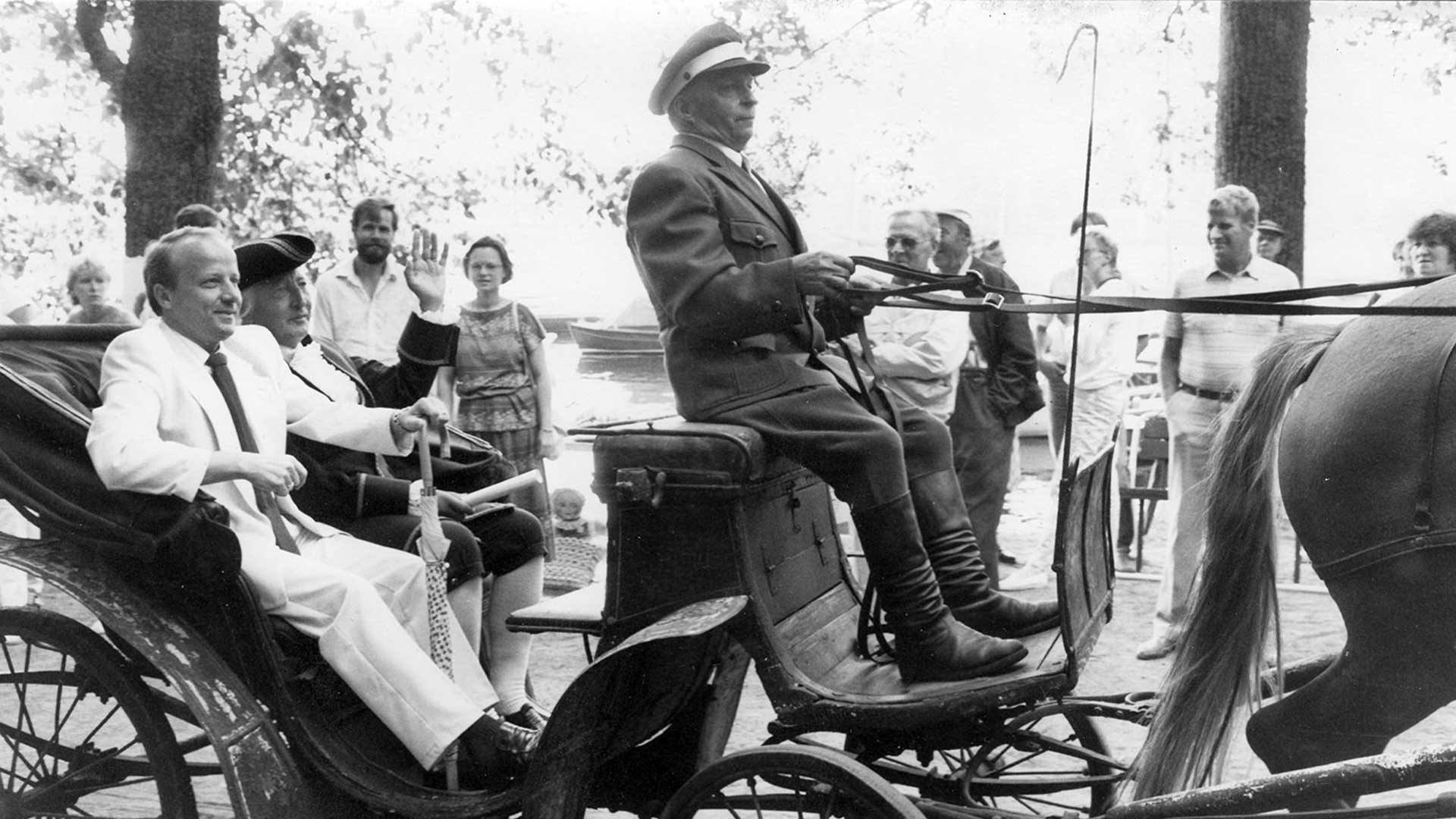
Market square veteran, market trader, international match cheerleader, host of the Kexholm celebrations, Karelian tribal leader and much more. Veikko Mykrä managed to be many things and involved in many places. The people of Heinola knew him as a market trader wearing a birch-bark hat, but the man was also known at the Stockholm Olympic Stadium.
Mykrä came from Antrea. He was actually born on a train on the way to the maternity hospital in Viipuri. Secondary school, which started in Imatra in the autumn of 1939, was interrupted by the Winter War and the evacuation journey to Tammela. School continued in Forssa, and alongside his studies Veikko sold chip baskets and birch-bark rucksacks made by his mother at the market square. In the autumn of 1941, the Mykräs returned to Antrea; Veikko first went to work at the cooperative store and from there to the Viipuri engineering workshop to train as a filer, with the goal of becoming a train driver. A second loss of their home interrupted those dreams, and a new evacuation journey took them to Hämeenkyrö and Hattula. There, the Mykrä family earned a living by fishing and practising the trade of charcoal burning.
The year 1948 was a time of great change. Veikko attended Sairala Evangelical Folk High School, which was evacuated in Janakkala, and moved to Heinola. The following year he married Elli Ojalainen, originally from Ilmee in Rautjärvi. The family had six children.
The family's livelihood came from the skill of trading brought from a Karelian home. Veikko and Elli ran a general store in Tommola, Heinola, from 1949 to 1951.

”Brought by the wind, gone with the wind”
After that Veikko went around markets and organised auctions, and was starting to be at least a local celebrity. He started a snack bar in Heinola market square in 1955. Market trading expanded when the Mykräs bought a Fish and Greengrocery from Mrs Silvennoinen in 1965. His reputation in the market began to grow. Veikko's catchphrase became familiar to many: ”From wind and from rain. Veikko noticed that keeping quiet didn't lead to any good, and he made sales through sales pitches and waking up customers. There were plenty of words and talk. With humour, good service and brilliant products, business was booming.
”In the middle of the market square he was constantly like he was in a shop window. Veikko was the life and soul of everything and surely in his time also Heinola’s best-known Karelian, says Veikko and Elli’s son Veli-Matti ”Velkki” Mykrä.
Operations expanded when the Mykräs started a market café in 1980. Elli's doughnuts became well-known.
Karelianism caught on
A growing family and a bustling business life left Karelian identity waiting for its moment. Then, in 1979 at the Karelian Summer Festival in Nurmes, Karelian identity truly took hold of the evacuee boy. He bought a birch-bark hat, which became his trademark, and attached a Karelia cockade to it with a safety pin.
Veli-Matti even says his father was a Karelian anarchist – the safety pin referred to punk rock.
Even before the trip to Nurmes, Veikko had been on the board of the Heinola Karelian Society since 1975. Soon after buying his hat and cockade, Veikko's involvement shifted into a higher gear, and he also served as the society's chair for over ten years.
”Before that, being Karelian wasn't a big deal in Veikko's life. Of course, looking back, there was a strong Karelian community in Heinola and the Karelians stuck together. A large proportion of Veikko's friends came from Käkisalmi. Long after the wars, Karelians preferred to buy from Karelians, that was a clear rule,” Veli-Matti Mykrä recalls.
The birchbark hat and cockade became a symbol of Veikko and Karelianism.
”A market vendor brought father a membership form for the Karelians of the Heinola region. Veikko got involved in the activities, and as a talkative man he was soon on the entertainment committee and before long even the chairman.”

Clan chief and market bailiff
Mykrä acted as the host of the Käkisalmi Foundation's Käkisalmi Festivals for some ten years. At the festivals, Industrial Counsellor Eino Kolli named Mykrä a tribal leader of the Karelians. Another significant title was the rank of market kivalteri, awarded in connection with the Heinola Heritage Market.
Aside from his oratorical gifts and birch-bark hat, recognition was also brought, according to an assessment by Veli-Matti Mykrä, by his distinctive appearance. Veikko was easily noticed.
Veikko was a passionate sportsman. Finnish baseball and chess were Veikko's disciplines, but his greatest, or at least most visible, achievements were as an armchair sportsman.
At least he was actively involved in arranging the Finnish baseball Federation vs. Press match in Heinola.
”I was reportedly starting to be born, and my father, who was leaving for a pesäpallo match, told my mother that if she left now, she could get a lift to the hospital at the same time,” says Veli-Matti Mykrä.
Shouting crew in Stockholm
The Finland-Sweden athletics international at Stockholm's traditional stadium was important. Mykrä acted as a volunteer cheer squad leader and directed chants with a single finger on one hand and an umbrella in the other. Even the Swedish press paid attention to him. Pekka Tiilikainen read verses written and printed by Mykrä on the radio.
”Veikko had fallen in love with the atmosphere at the Stockholm stadium, which was completely different from the one at the Helsinki stadium. In Stockholm, he was the cheerleader and, being utterly barking mad, roamed all around the stands. He had had his own supporting chants printed at a printworks and was handing out leaflets to the crowd. Veikko and his mate showed which verse should be chanted and when. Legendary commentator Pekka Tiilikainen read the verses on the radio. They lost their voices shouting those chants, and not a peep came out of them at home for a while,” Veli-Matti Mykrä recounts.

The cockade wasn't good enough for Hesari
Mykrä also gained nationwide publicity. In the 1980s, he was used in advertisements by both Etelä-Suomen Sanomat and Helsingin Sanomat. ”A good news paper is fit to be used as wrapping paper tomorrow,” marketed ESS. The picture showed Veikko Mykrä with his birch-bark hat at Heinola market, by the fish crates of Fish and Vegetable Shop V. Mykrä. Helsingin Sanomat asked who would have the final word. And in the picture, it was Veikko Mykrä who said it.
”At that time we were still very much living in the era of Finlandisation. In the Etlari advert Veikko was allowed to keep his Karelia badge, but in the Hesari TV advert it had to be removed.”
Tolerance
Veikko's sociable disposition and Karelian tolerance were also visible at home.
”When rock and roll started coming to Heinola and hair to grow, we let the children grow wherever they were heading – as long as they kept their heads. Tolerance was an important thing at home. When I later started playing in the band Nypykät, Veikko followed it really closely and could list the gig venues.”
Being Karelian could sometimes also be a burden. Evacuees stuck together a lot in Heinola, but the next generation also had a hard time. Even Veikko Mykräki needed life experience and self-confidence before he began walking around publicly in a Karelian cockade and birch-bark hat. The hat stayed on his head not only at the market square, but in his leisure time as well.
At Myyri's home, the Karelian dialect was spoken, even by the children. But outside the home, at school, the dialect was hidden.
”Not everyone looked favourably on Karelian culture at the beginning. At home it was of course a different story, but outside the home you didn't really dare to be Karelian when you were young, and sometimes it was even a burden. Palm-branch tapping was dying out at one point and the Karelian League launched a major palm-tapping campaign, and even we were forced to go and tap old grandmothers and aunts. It was one of the worst times of my life. My eldest sister walked on the other side of the street because she was so embarrassed. Later on, palm-branch tapping has once again become a living part of things, and my children go and tap my mother as long as she lives, Veli-Matti Mykrä says.
According to Veli-Matti Mykrä, the Karelians stuck together in Heinola, and perhaps this withdrawal into themselves was at the same time also an opening up.
”As a child I didn't feel at all that we were Karelians from the Karelian Isthmus at home. To a little person, home was in Heinola, and my parents” immense yearning for ceded Karelia was incomprehensible and sometimes, in my teens, even annoying.”
Veli-Matti Mykrä began to understand Karelian identity and homesickness better when he realised that it was not just about the break-up of a single parish, but of an entire community of 400,000 people scattered across Finland, becoming part of a new kind of Finnishness.

