Käkisalmi Women's Association

In December 1849, the Russian officer Rafail Aleksandrovich Chernosvitov was exiled to Kexholm, where the years of exile passed well. When the exile sentence ended in 1854, the officer wanted to reward the town by donating 500 silver roubles, on the condition that the ladies of the town would establish and maintain School for poor children. The donation led to the founding of the Kexholm Women's Association in the spring of 1855. Right away in the autumn, the donation began to be augmented by organising the first major lottery, and on Catherine's Day, 25th November, a grand celebration and ball.

In issue 99 of the Wiborg newspaper, the Kexholm correspondent reports obtaining ”high official” permission to establish a women's association; its purpose would be to get the said school up and running as soon as possible, thereby offering the women of our town the opportunity to work towards promoting such a good cause. The enthusiasm exceeded all expectations, and within a few months 139 lottery prizes had already been collected, largely quite fine handicrafts, which would be raffled for the benefit of the school in question. From exhibition fees for the lottery tickets alone, 20 silver rubles and 30 kopecks were amassed, even though the admission fee was merely 5 kopecks. 650 lottery tickets were sold, raising 325 rubles, and in addition there came another 48 rubles and 40 kopecks from the ball held on Sunday the 25th of November. Thus, the women's association had gathered its founding capital of 393 silver rubles and 70 kopecks. "It is to be hoped that enthusiasm for the cause will always remain as widespread and as warm as it has been thus far."
The charity school was founded in 1859. The children were taught to read, write, do arithmetic, sing and do handicrafts. The town's madams served as teachers. The association paid for everything. The school was in operation until a proper primary school was founded in Kexholm in 1876. Even after this, the Women's Association was responsible for the clothing of the poor children at the primary school. The association also provided support when the town's first co-educational secondary school was founded in 1892.

Following the establishment of the primary school, it was decided in 1885 to establish and maintain Craft school. The school was divided into weaving and sewing departments. The association paid the teachers' salaries, purchases and operating expenses. The name of the school changed in 1936 to the Kexholm Women's Home Craft School. Today it is part of Mikkeli Vocational College. From an early stage, Kexholm national costumes were also made at the school.
Alongside the handicraft school, the association carried out various kinds of charity work for the less fortunate; it maintained a swaddling-clothes and domestic-help club, organised emergency relief work for women upon request in 1919, looked after orphan children left in the town and paid grants to pupils of the primary school and co-educational secondary school right up until 1939.
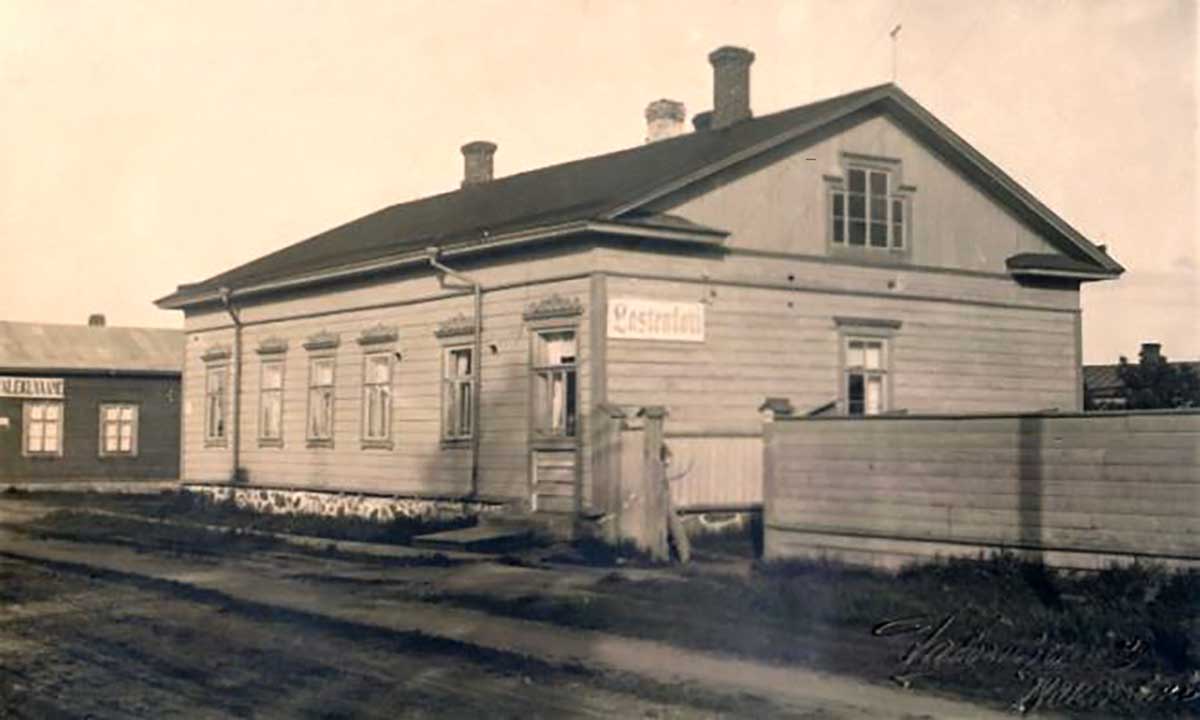
In 1938, the association bought the former Tenkalahti primary school building, the so-called ”Valistustalo”, and renovated it during the 1938-1939 winter season into a home crafts school. It also included a teacher's residence and office and meeting spaces for the association.

The Winter War began on the last day of November. Already in the December bombardments of 1939, a storage building in the schoolyard took a hit and burned to the ground. The journey of the evacuees began. The school initially moved to Lappeenranta and later to Mikkeli.
After the war, the association donated a significant portion of the compensation it received for property left behind in Karelia to the Mikkeli Home Industry School (1947). A year later, in December, the Home Industry School was finally handed over to the Mikkeli Province Home Industry Association.
The association has continued its operations from Helsinki by, among other things, organising monthly meetings for its members and actively participating in events organised by the Käkisalmi Foundation. The women's association has also taken an interest in its home town's co-educational secondary school of Käkisalmi, which was relocated to Turku in the autumn of 1944 by a decision of the Council of State. The school continues its work there as the Turku Normal School, to whose pupils the association has frequently donated grants.
The activity, selflessness and self-sacrificing work of the women who operated in the Käkisalmi Town Women’s Association, even before the war for nearly a hundred years, greatly enriched the miniature Käkisalmi, the city of apple blossoms.
Today, the association's most important tasks are cherishing and preserving the culture of Käkisalmi and Karelia, together with a togetherness tinged with reminiscing. The association will celebrate its 170th anniversary on St. Kaisa's Day in 2025.
The Kexholm Town Women's Association also had a Lappeenranta branch and a Heinola branch
of the Lappeenranta department The inaugural meeting was held on 3 February 1965 at Kerttu Nokelainen's home. Eleven people were present. Aino Pettinen was elected as the chairperson of the branch. The number of members gradually increased, and by 1967 there were already 17 full members and 5 supporting members.
The year 1967 was significant, as the Lappeenranta branch, having heard from Rector Mustala about the saved altarpiece of Kexholm Church, began to look into the matter with the help of the Helsinki association. It turned out that the altarpiece of the old Kexholm Church and another painting in the church named ”The Last Judgement” were in the possession of the Church Board. Through the cooperation of the Helsinki Women's Association and the Lappeenranta branch, the Church Board transferred a total of four altarpieces to the Lappeenranta Art Museum. Over 60 people were present at the ”unveiling ceremony” of the paintings.
The meetings of the Lappeenranta branch were held on the first Wednesday of every month. At the branch meetings, they sang, read stories, and excerpts from letters and books. The branch also invited all former residents of Käkisalmi living in Lappeenranta to lunches organised by the Course Centre. These were popular gatherings where people heard accounts and experiences from those who had visited the forcibly ceded Karelia and Käkisalmi, among other places.
As the members of the branch aged, the discontinuation of activities was already discussed in 1983, but the outcome of the discussion was a decision to continue. Although there were still 19 members and two male members involved in the activities in 1986, it was deemed best to wind up the branch, mainly due to the ageing of the members. The remaining and supporting members joined the Helsinki main association. The final meeting was held on 20 November 1987.
Heinola department established on 9 April 1970 in the resettlement locality of the people of Käkisalmi on the initiative of Anna Sihvo. She served as the first chairperson of the Heinola branch from 1970–74. There were 24 members involved at the time. The club room of Kristiinakoti was often used as a meeting place, and the Christmas parties were celebrated at Heta-Muori. In 1973, all people of Käkisalmi living in Heinola were invited to the Christmas celebration, and 48 of them attended.
Among the visitors to the meetings were Rauni Lähteenkorva, artist Armas Lähteenkorva, and Sanni Leinonen with Aino Ollila's handicrafts. Several members of the Heinola branch had a self-made Käkisalmi and/or ancient Finnish national costume.
Of other activities, mention should be made – in addition to moments of reminiscence – of a trip along the Saimaa Canal to Leningrad, in 1978 to the Kuortti glassworks, in 1979 to the Bomba House, to Turku, and in 1991 to the Kuortti manor, including the villas of Elsa Kari and others.
In 1990 the membership was 23 members plus honorary member Anna Sihvo. Apparently due to the ageing of the branch's members, it was decided to wind up the branch on 7 April 1992. People from Heinola have since joined the main association.