Spiritual life
The influence and spiritual control of the Western and Eastern churches in Kexholm strongly depended on the balance of power between two states competing for dominance, Sweden and Novgorod/Russia. At the end of the thirteenth century, Sweden had not yet managed to extend its power to Karelia and Kexholm, but after the Third Crusade in 1294, a Swedish military force arrived in Kexholm and captured the castle. As early as the following year, the Novgorods wrested the castle back for themselves. The Treaty of Nöteborg in 1323 marked the first significant political and, at the same time, religious division of Karelia, the effects of which were also visible in spiritual life, and which caused conflicts between the Christian Western and Orthodox churches.
 Lutheran churches
Either 1580 or 1611 is considered the founding year of the Käkisalmi Lutheran parish. During the first Swedish occupation from 1580 to 1597, a bell tower was built in the castle area (1584). Four years later, the construction of a wooden church began, which was completed around 1591. The parish even got its own clergyman. In the following decades, fire destroyed the churches.
In 1692 was consecrated Käkisalmi Castle Church, which was a stone church and thus a rarity and the town's pride. A wooden bell tower, which also housed church bells, was built to the east of the church.
The Great Northern War, or the so-called Great Wrath, broke out in 1700 and Kexholm soon became involved in the war. Peter the Great conquered Kexholm in 1710, at which time the Lutheran stone church had to be handed over to the Greco-Catholic Church, which used it until the 1830s. Lutheran services were held in temporary shelters.
The Treaty of Nystad was concluded in 1721. The new border was established roughly along the lines of the present-day frontier. Sweden was forced to cede to Russia the southern part of the County of Kexholm, Ingria, Estonia, Livonia, and the western Karelian Isthmus. Only the northern part of the former County of Kexholm remained part of Swedish territory in Finland. In the territories of both countries, the inhabitants were guaranteed, amongst other things, the right to their own religion. At that time, the Diocese of Saint Petersburg managed the affairs of the Greek Catholic parish of Kexholm.

Built in 1681 and consecrated in 1692, the garrison church of Kexholm Castle was the town's first Lutheran church.
It had been promised that a new church would be built to replace the lost one. The decision to build the church was not made until the mid-1750s, in an area where the town was gradually taking shape. As the work of the renowned church builder Tuomas Suikkanen, there was completed in 1759 beautiful, well-proportioned cross church, which was dedicated to Saint Andrew. It became familiar and dear to the people of Käkisalmi. The church was adorned with several old and valuable oil paintings, including an altarpiece painted by B. Godenhjelm, which was later moved to the new church. The beautiful chandeliers and, for their time, valuable organ were donations from a local benefactor, the Greek Catholic Audotja Andrejev. The organ was built by J.A. Zachariassen in 1889. The church remained unheated to the end.

A wooden cruciform church completed in 1759.

Interior of the Old Wooden Church.
The bell tower building near the church is thought to have been designed by the Italian Carlo Francesco Bassi, who worked in Engel's Intendant's Office.  Wooden bell tower was completed in 1824 and had two large church bells. One, made of steel, was manufactured in Bochum, Germany in 1897 and the other, smaller one, cast from bell bronze, in the town of Valdai, Russia in 1877. The larger bell bore the inscription: ”Let everything that has breath praise the Lord, Hallelujah. Ps. 150:6”. Later, the church bells were moved to the tower of the new church. As the population of the town and rural municipality grew, the church also began to feel cramped and its condition to deteriorate. However, a new church was not obtained. The old church was repaired and used for 150 years until the Russians burnt it down during their retreat in 1941.
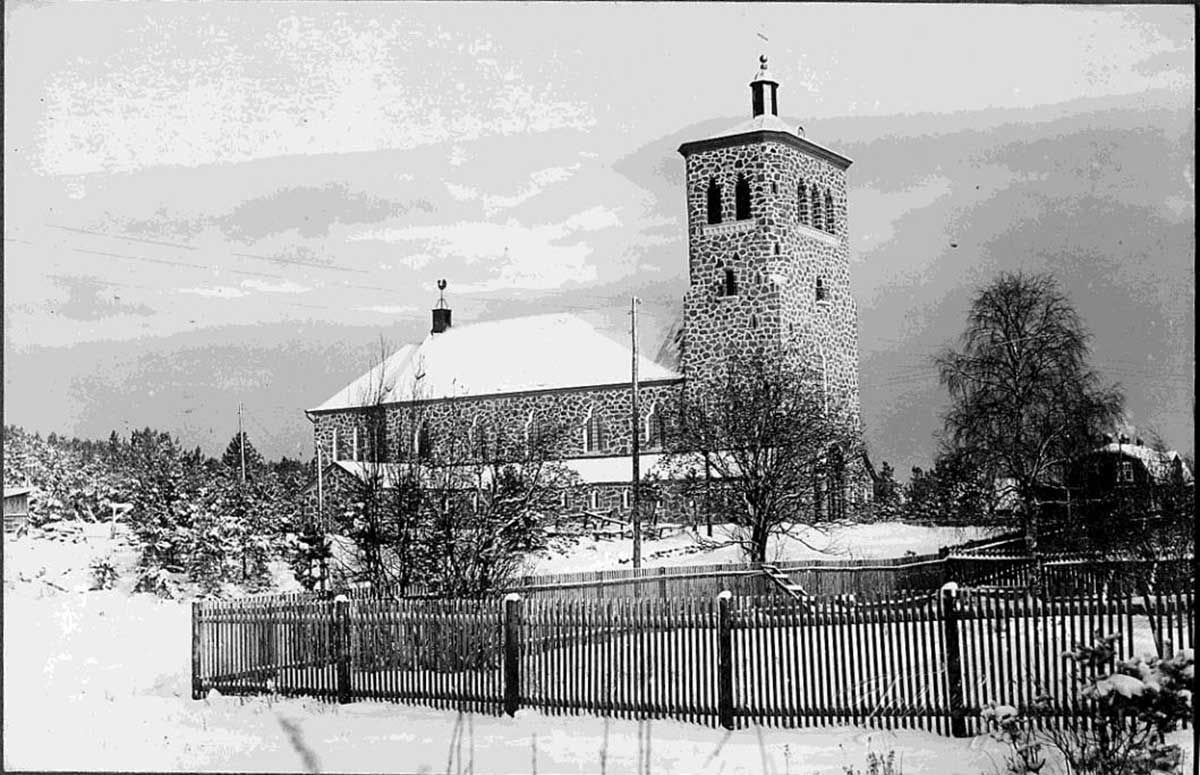
New church It was planned for years, and finally in 1928, the plan designed by Armas Lindgren was approved. The new stone church was consecrated on 14 December 1930. The consecration was performed by Erkki Kaila, Bishop of the Diocese of Vyborg. Transferred to the new church from the old cruciform church were the altarpiece painted by B. Godenhjelm, the organ donated by Avdotya Andreyevna, and both church bells from the old church belfry. In 1937, the church council acquired a new organ for the church. The organ was designed by the artist Venni Kuosma and manufactured by the Kangasala Organ Factory. The organ had 32 stops. The pulpit of the new church was decorated with statues of the apostles carved by Albin Kaasinen.
As the new church also gradually proved too small, the old prayer house, which was thoroughly renovated in 1937 for the parish's needs, was used. The church suffered severe damage during the war.
The last vicar was Niilo Aatos Mustala, who in 1933 was chosen as the successor to Konstantin Helén, who had served in the post since 1896.
Many sacred objects and textiles were rescued from the ravours of war to Finland. Furthermore, Petter Lang's altarpiece entitled ”The Last Judgement”, originally from the old timber-framed church of Kexholm, as well as the altarpiece ”Jesus on the Cross”, painted in 1872 by Berndt Abraham Godenhjelm and located in both the Old and New Church, were successfully brought from the ravours of war to Finland, to the Lappeenranta Museum. Unfortunately, in 1972 a fire broke out in the museum in which Jesus on the Cross was burnt beyond repair, but Petter Lang's altarpiece The Last Judgement was able to be restored, despite the damage caused by the fire. During the 1972 fire, there were also two other altarpieces in storage: Jesus on the Cross, painted in 1743 by Petter Bergström, and The Burial of Jesus, completed the following year. They survived the fire.

Käkisalmi New Church.
The Kekskholm Prayer House Association was founded at the beginning of the 20th century and the prayer house was built at the corner of Vuorikatu and Torikatu in 1914. The YWCA had its home and right of use in the building. The space was also used for revivalist activities and the parish boys' clubs. Around the same time, there were a few dozen sectarians, Laestadians and Free Church members in the town. Active Salvation Army operations also began.

The tax book (tax book of the registered population of the Votic Fifth) from 1500 mentions that there were two Greek Orthodox churches in Kexholm: dedicated to the resurrection of Christ and the Church of the Resurrection of Christ Dedicated to the memory of the Saviour parish church, or the Church of Spas on Spassky Island opposite the castle. The third church is believed to have been on the castle island, the Yegoryevsk or St George's Church.
In the 1740s, a Greek Catholic prayer house was built on the shore at the confluence of the Vuoksi and Lake Ladoga. When the waters of Lake Ladoga rose exceptionally high in 1805–07, the sanctuary was moved near the harbour pier up onto a sandy embankment, from where its dome served as a landmark for fishermen and seafarers. The sanctuary was moved once more to make way for railway construction, to the so-called Hamina field, from where the dilapidated prayer house was dismantled in 1936.

Greek Catholic Church of the Nativity of the Virgin Mary (1847).
The stone church on the barracks area, which had been converted from a Lutheran church into a Greek Catholic church, began to crumble and was abandoned by the parish in 1836, and it was demolished in 1898. In its place, a new Byzantine-influenced main church designed by the famous Italian-born architect Louis Tullius Joachim Visconti was acquired, which has two names: Church of the Nativity of the Virgin Mary yes Church of the Nativity. The church was consecrated in 1847. The church was entered by doors from the north, east and west. There were 8 windows in the dome, as well as in the walls on two tiers, the lower of which were fitted with iron grilles. Three stoves were made of tile and the church floor was of wood. On the inside of the dome was depicted the face of the Lord Almighty, on the west side the Assumption of the Mother of God, and on the walls images of the four Evangelists. The iconostasis was covered with a precious silver revetment. The most significant icons of the church are mentioned as being the Praise of the Most Holy Mother of God and the holy images of Saint Nicholas. The first-mentioned icon was painted in Valamo in the mid-18th century and is currently kept in the Orthodox Church Museum in Kuopio.
With the donation funds of Eudokeia Andrejev, a merchant's daughter from Käkisalmi, the town also had a Greek Orthodox cemetery church built in 1891–92, namely All Saints' Day. It was designed by Jac. Ahrenberg in 1894. The church was consecrated on 2 June 1894 by Antoni, the first Greek Catholic Archbishop of Finland. A prayer house decorated with woodcarvings was also built next to the church.
Although the Greek Catholic parish was not very large in terms of its membership, it included the most influential figures in the town. They had a significant impact on the town's municipal and economic development.
The independence of the Finnish Orthodox Church was foreshadowed by the formation of a separate diocese for the region of Finland in 1892.

The Church Hall of the Virgin Mary.
Monasteries
According to the tax book, there were already three monasteries in the town at the beginning of the 16th century. Of these, the remains of the Convent of Saint George were found during railway construction work. The monastery was located around the site of the police station from the era of our independence. The Monastery of Saint Nicholas was located in the town, but its exact location has not been pinpointed. The Monastery of Saint John is mentioned as having been built at the mouth of the stream. It is deduced that the monasteries of Kexholm were monasteries and not, for example, sketes of the Valaam or Konevits monasteries.
The Konevitsas Monastery had a property in Käkisalmi at Kaivokatu 3. Before the wars, the lands of the monastery's old farm in the village of Pärnä in Käkisalmi were rented out to neighbouring farmers. The town clergy of the Konevitsas Monastery received help with ecclesiastical duties when needed. The igumen and monks were a familiar sight in the urban landscape of Käkisalmi. The monks of Valamo also visited Käkisalmi, although the journey from Valamo to Käkisalmi was considerably longer and, in the event of a storm, more difficult.

Greek Catholic cemetery church (1894) and Greek Catholic prayer house decorated with wood carvings (1863).