Kalevala jewellery is part of an intergenerational tradition
SISKO BJÖRK – STRONG MEMORIES FROM JEWELLERY
Sisko Björk's relationship with Kalevala jewellery is multifaceted. She has acquired and inherited several pieces of jewellery, which are associated with strong memories and family stories. The snake brooch is a piece of jewellery she bought second-hand. Its prototype is a Merovingian-period brooch found in Hattelmalanharju, which is considered the finest of the Iron Age. Despite its name, the pattern does not depict a snake, but rather a figure-eight ribbon and a beast's head.
Häme festive jewellery (now. Paradise) is particularly important to Björk because her mother received it as a 50th birthday present from her husband from Häme. Her mother, who had a background as a Karelian evacuee, cherished the piece of jewellery as a great treasure, and Sisko, who received it as an inheritance, appreciates its understated elegance.

Sisko Björk
A woman's voice is a suffrage centenary jewellery piece designed by Kirsti Doukas. For Björk, it symbolises strong women and the Kalevala Women, whose activities she was drawn into by a friend of her mother.
Halikko necklace relates to a unique 12th-century silver hoard, and for Björk it is the symbol of Kalevala Koru.
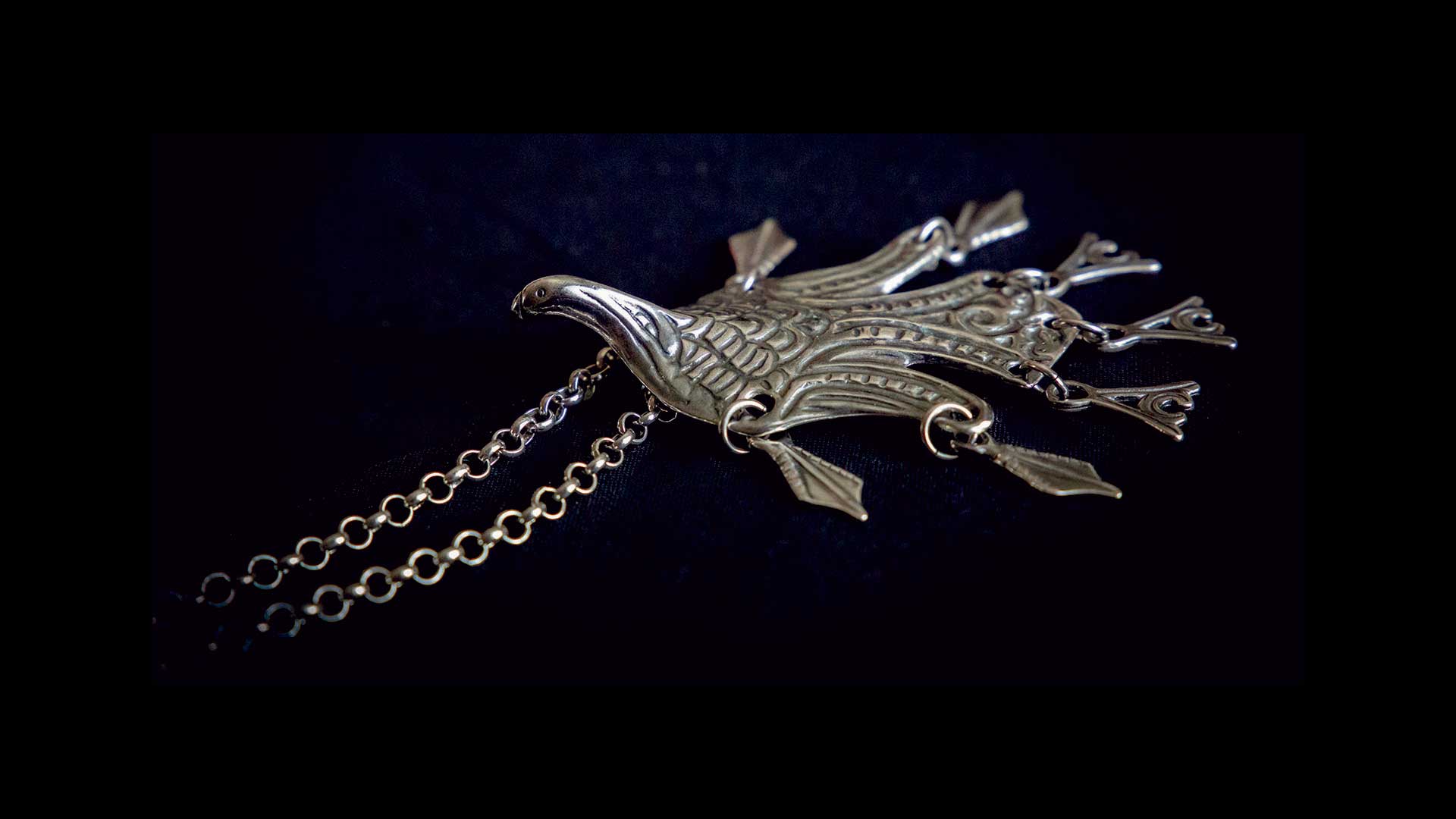
Uhtuan sotka It is a bird pendant containing Christian symbols. Its significance is enhanced by the fact that the Speaker of Parliament, Riitta Uosukainen, has also worn it.
My sister has several bracelets, such as a Viking Age-inspired one The bird and the clock and which also symbolises the scouting movement Teljänneito. The versatility of bracelets makes them appealing.
Kalevala and Kanteletar have been part of Björk's life since childhood. She recited poems in inter-school competitions and later to her grandchildren. She regards Kalevala jewellery as a family heirloom and a token of love – a link between the past and the future. They are a hobby and a world of her own, which she also shares with her grandchildren as gifts.
SINI AND NENNA VALONEN – KALEVALA JEWELLERY: MULTIGENERATIONAL CULTURE
Sisters Sini (18) and Nenna (25) Valonen are continuing the heritage of Karelian evacuees in the fourth generation. In their lives, Karelian traditions, a sense of community and Kalevala jewellery go hand in hand. Their maternal grandmother, Mumma-Sisko Björk, has played an important role in preserving and passing on these traditions.
– We have been ”vaccinated” with Karelian traditions since we were little. They are always a part of our everyday life and are visible in the family's life in a positive way across generations, Nenna says.

Nenna Valonen
Jewellery has a story
Nenna remembers vividly the moment she received her first Kalevala piece of jewellery:
– I got my first Kuutar My Kalevala jewellery from Grandma when I was 14. Ever since then they've been with me, she smiles.
Fiery and strong-willed, Nenna has always wanted to look after others. For her, jewellery is not just decoration, but an important part of identity and self-expression.
– Youth culture is tolerant nowadays. It provides the opportunity to combine different things, and jewellery is a way for me to bring out my roots, Nenna says.
Life is busy: studies at Hämeen ammattikorkeakoulu, work with taken-into-care children and young people, and family life with a husband and a small boy fill the days. Still, there is also time to be found for one's own family and Grandma.
Nenna has a substantial collection of Kalevala jewellery. Included are silver, among other things Halikko screw collar - jewellery, bronze Kuutar- jewellery, a Kalevala ring with a granite stone and Kaleva bear -series. In everyday life she mostly uses silver jewellery, but for parties she dresses up in striking bronze classics.
– Kuutar- jewellery is still the most significant. They were the first ones I ever received, Nenna says.

Sini Valonen
Music goes everywhere with you
The younger sister, Sini, has loved music since childhood. The hobby began in music play school in Hartola and continued at the Heinola music institute with piano playing until the age of 16.
– In the future, I want to work with music and learn to master its production as a whole. My goal is to train as a music technologist, says Sini.
At present he is studying music at Salpaus Further Education in Lahti and will soon begin a work placement at the legendary Finnvox Studios in Helsinki. Because of the placement, he has moved to the capital region.
Alongside her studies, Sini also plays in her own band. An all-girl band Babestation combines alternative metal and punk.
– Some of our own production has also been created, and we'll be hearing it soon, Sini hints.
Kalevala jewellery as a symbol of sisterhood and tradition
Kalevala jewellery accompanies Sini in her everyday life and performances too.
– They are part of me and my heritage. The jewellery also symbolises my relationship with my family and my traditions. It has been wonderful to be involved in Mumma's projects, says Sini.
Her dearest pieces of jewellery belong The heart of the home -series, which Mumma has put together for her in its entirety.
– I'll use The heart of the house everyday use, but for parties I'll also take, for example The Heart of Eura - earrings, Uskela bracelet, Rabbit and the ring Kaleva bear - jewellery, Sini lists.
Bridge between generations
The siblings' story demonstrates how traditions and one's own identity can remain vibrantly present in modern times. For them, Kalevala jewellery is not merely jewellery, but a link to the past and a bridge between generations – a connection that carries the family's stories and values forward.


