The ships of Lake Ladoga
Ever since the Stone Age, Lake Ladoga has been part of a versatile waterway network used for travel between the White Sea, Lake Ladoga, Lake Saimaa, Lake Päijänne, Lake Inari, the Gulf of Bothnia and the Gulf of Finland. The routes were used in both winter and summer for hunting and trading trips. People, goods and culture have all travelled along them.
Based on rock paintings, it has been estimated that the earliest boats were skin boats, but no archaeological finds of them have survived. It is thought that the skin boat was followed by a plank boat made using sewing or stitching techniques, and a logboat equipped with side planks. Since the Second World War, several sewn boats have been found in the Saimaa region. One might suppose that similar vessels were also used on Lake Ladoga. Dozens of logboats have been found in excavations across various parts of Finland, remaining very similar for centuries.
In the inland waters, the term kavassi was still used for cabin cruisers towards the end of the 16th century. At sea, the kavassi seems to have been a fast vessel equipped with six to eight oars.
At that time, ordinary rowing boats, dinghies, logboats and touring boats as well as lighters were also in use on the inland waterways. Archipelago boats, kavassi boats and touring boats manufactured on Lake Saimaa, as well as tar, hemp and sailcloth for shipbuilding, were brought to Lake Ladoga in Kexholm. Fast lighters and logboats were built on Lake Ladoga for the navy's needs.
In the Middle Ages, the great northern trade route ran from Lake Ladoga, probably from Käkisalmi northwards via Kilpolansaari to Pyhäjärvi in Kitee, from there via Puhos to the Pielisjoki river and up to Lake Pielinen. From there, travel continued eastwards along the Lieksanjoki river and northwards along the Oulujoki river system towards the area of present-day Oulu. The Hiitolanjoki river was used to travel between Lake Ladoga and Särkilahti on Lake Saimaa. In these areas, rivers, lakes, streams and rapids span distances of tens of kilometres, and there are several alternative routes. To the south, seafarers travelled along the Neva to the Gulf of Finland.
From the 10th and 11th centuries onwards, there have also been connections from Lake Ladoga to the White Sea. Disputes over fishing waters between Karelians and Russians are known from the 15th century.
Right to ships
The shores of Lake Ladoga passed to Sweden in the Treaty of Stolbovo in 1617. The inhabitants of Kexholm were granted the right to build and buy ships. No records of the volume of trade have survived. Tar and butter were mainly exported to the south, and salt and tobacco, among other things, were imported from there. In addition to Nyenschantz, trading voyages were made from Lake Ladoga to at least Stockholm and Germany. At the end of the century, the ownership of Ladoga vessels became concentrated on the coast of Impilahti.
Following the Peace of Stolbovo, both Sweden and Russia built up inland waterway navies consisting of dozens of different types of vessel.
Ships also travelled on Lake Ladoga from Nyen and Aunus. They mainly transported tar south and salt north.
Before the era of sailing ships, long-distance transport took place at least on Lake Saimaa using privately owned three- or five-oared boats equipped with cabins and sails. The state obligated parishes to build parish boats for official transport. It has been estimated that the type of these boats may date back to the Viking Age. Later church boats were based on these parish boats.
Peasant shipping on Lake Ladoga and in the Viipuri Province more generally was for a long time domestic shipping. It was used to acquire supplies for personal use that people were not able to produce themselves. Peasant vessels were used to take agricultural and forestry products from the shores of Lake Ladoga to be sold in St Petersburg. For a long time, seafaring was not an independent livelihood; instead, shipowners were typically also farmers. Gradually, ships also began to represent commercial enterprise when goods other than their own products were transported in them. Skippers gradually also became intermediaries and sellers as freight transport grew. The title of skipper appeared in rural census registers in the latter half of the 19th century.
 Often ships were in co-ownership due to the high risks and required capital. Shipowners were often tenant farmers, and co-ownerships between neighbours and relatives were common. Unlike in the Gulf of Finland, on Lake Ladoga ship owners were only rarely the ship's masters.
Peasant-built vessels were important. They made it possible to improve the profitability of agriculture and animal husbandry. In the 18th century, Russia established several shipyards on the southern shores of Lake Ladoga. Through them, Dutch influences reached Ladoga's vessels, and new ship types emerged on the lake, such as the *soima* (or *donskotti*) and the galliot. In the 18th century, increasingly large ship cargoes began to travel on Lake Ladoga as Ruskeala marble was transported to St Petersburg and sawmill products to Western Europe.
In the following century, timber, bark or willow bark, shingles, stones, firewood, fish and butter were exported to the south. A large part of the imports consisted of grain and salt, but a wide variety of utility goods also began to fill the ships.
In 1842, the province of Viipuri had a total of 422 ships. Of those, 64 were on Lake Ladoga. The number of ships was large, but they were smaller than those in Western Finland. The number of vessels on Lake Ladoga had decreased in the 1830s. The ships on Lake Ladoga were mainly in Jaakkima, Kurkijoki, Salmi, Impilahti and Sortavala rural municipality.
Lake Ladoga was an important route for freight and trade transport from the 1830s onwards. Most of the vessels were sailing boats and barges. The completion of the Saimaa Canal in 1856 shifted a great deal of traffic to Lake Saimaa. Traffic between Savonia and the Gulf of Finland moved away from Lake Ladoga. On Lake Ladoga, timber industry products formed the main part of cargoes from the latter half of the century onwards.
From the 1850s by steam
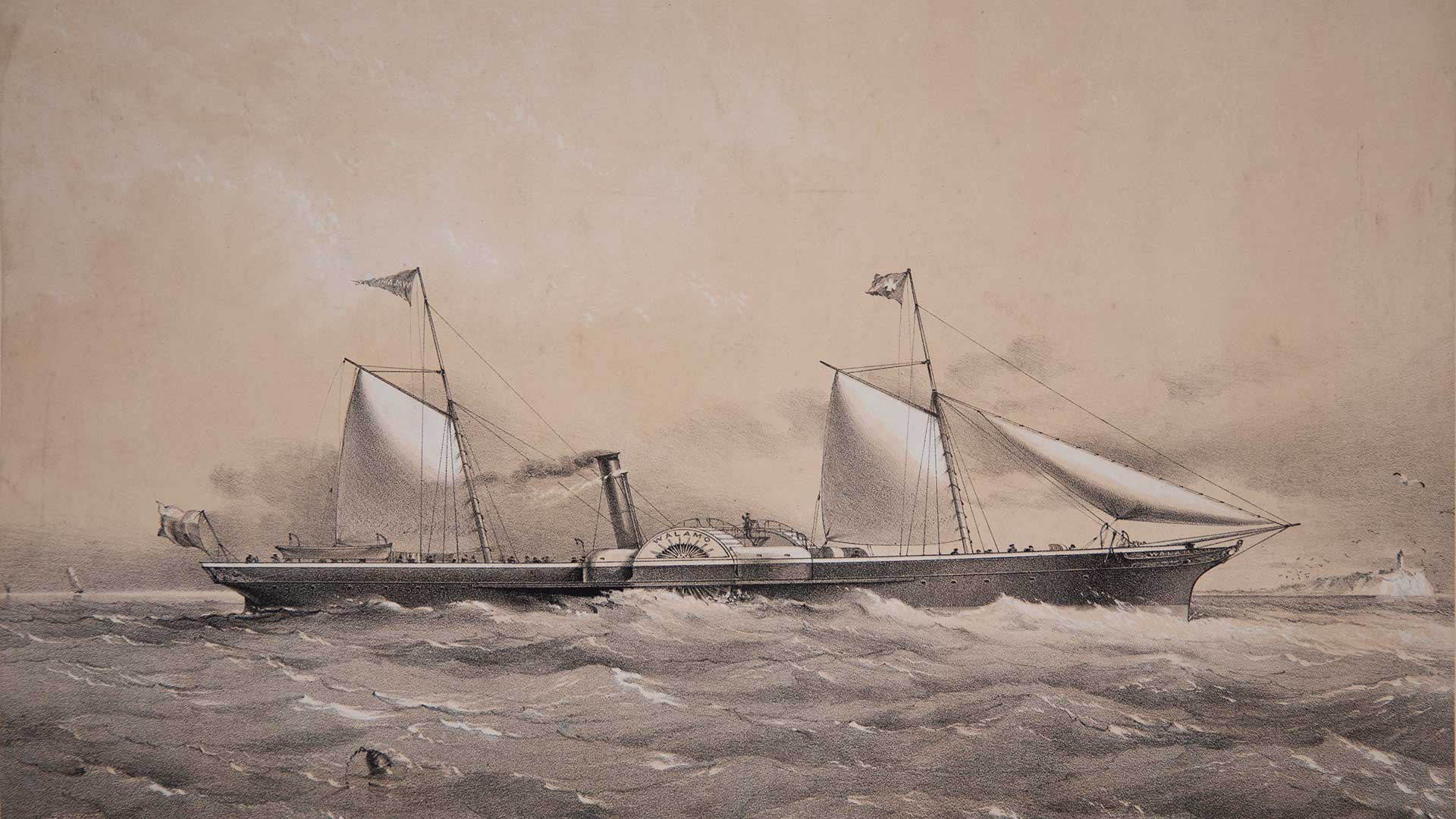
A significant change in navigation on Lake Ladoga took place in the 1850s, when steam began to replace sails. The first to start operations was the St Petersburg paddle steamer Pyotr Veliky (Peter the Great), which ran between St Petersburg and Petrozavodsk, and also called at Konevits, Valaam and Sortavala. With steam, vessels were able to keep to timetables and were no longer dependent on the winds. This changed shipping fundamentally. Steamships also required greater capital, which led to the establishment of new types of companies.
In 1859, Finnish businessmen acquired the vessel Walamo from England, which, in addition to paddle wheels driven by a steam engine, had auxiliary sails. The iron paddle-wheel steamship, as it was called in the newspapers, carried both passengers and cargo on scheduled services between Sortavala and St Petersburg, and called at least at Schlüsselburg, Kexholm, Konevits and Valaam. The Walamo was a 48-metre-long paddle steamer, and the Ladoga, acquired by the same company slightly later, was a 41.5-metre-long screw steamer.
Steamship traffic between Sortavala and Salmi in 1866.
In 1866 Lake Ladoga had three steamships. There were 84 larger sailing ships in total. Salmi had 36, Impilahti 30, Sortavala 14, Hiitola 3 and Sakkola 1 ship.
The 1870s were the golden age of Lake Ladoga's steamships. New enterprises had vessels built at shipyards on Lake Ladoga and elsewhere in Finland, and purchased steamships from abroad in particular. Shipbuilding took place especially in Impilahti, Sortavala rural municipality and the parish of Salmi. The speeding up of rail connections and the weakening of the economic position of Lake Ladoga's northern shore compared to the rapidly developed Karelian Isthmus reduced the importance of Lake Ladoga's shipping traffic.
During the last decades of the nineteenth century and the early part of the twentieth century, before Finland gained independence, several shipping companies operated on Lake Ladoga with numerous vessels. Scheduled traffic between the parishes was brisk. Traffic to the Valaam Monastery was particularly busy, with passengers arriving from both St Petersburg and Karelia. From Sortavala, there was regular shipping traffic to Salmi, Läskelä, Janaslahti and Pitkäranta, among other places.
Following Finland's declaration of independence, water traffic on Lake Ladoga changed. Active connections to St Petersburg and via the Neva to the Gulf of Finland quietened down. There was still brisk shipping traffic between Finnish localities.
The revolution shifted freight to the railways
The expansion of the rail network, Finland's declaration of independence and the Russian Revolution shifted a large part of freight traffic onto the rails.
A state of war existed between Finland and Soviet Russia from 1918 to 1920, and water traffic via the Neva was suspended. In the Treaty of Tartu in 1920, transit traffic between the Gulf of Finland and Lake Ladoga was agreed upon. Traffic did not begin until the summer of 1923. At that time, 201 Finnish vessels travelled along the Neva. In 1928, 701 vessels made the journey. Of these, 484 were steamships, 2 were motor vessels, and 215 were barges. 349 vessels travelled empty and 352 laden. Coal, salt, general cargo, stones, lime and Glauber's salt were brought to Lake Ladoga. Sawn timber and props in particular were exported to the Gulf of Finland. Firewood and earthenware were transported to some extent. Exports amounted to 104,000 tonnes and imports to just under 22,000 tonnes.
Traffic was hindered by the shallowness of the Neva, St Petersburg's bridges and the actions of the Soviet authorities. Transit decreased rapidly in the 1930s. In 1938, only 75 vessels passed through.
Following Finland's declaration of independence, waterborne traffic on Lake Ladoga from north to south was almost exclusively freight traffic. Tourist trips from Finland to St Petersburg and from Russia to Valaam ceased.
After the world wars, the majority of Lake Ladoga's ships remained on Lake Ladoga.


