The coaxers of the Ladoga ringed seal
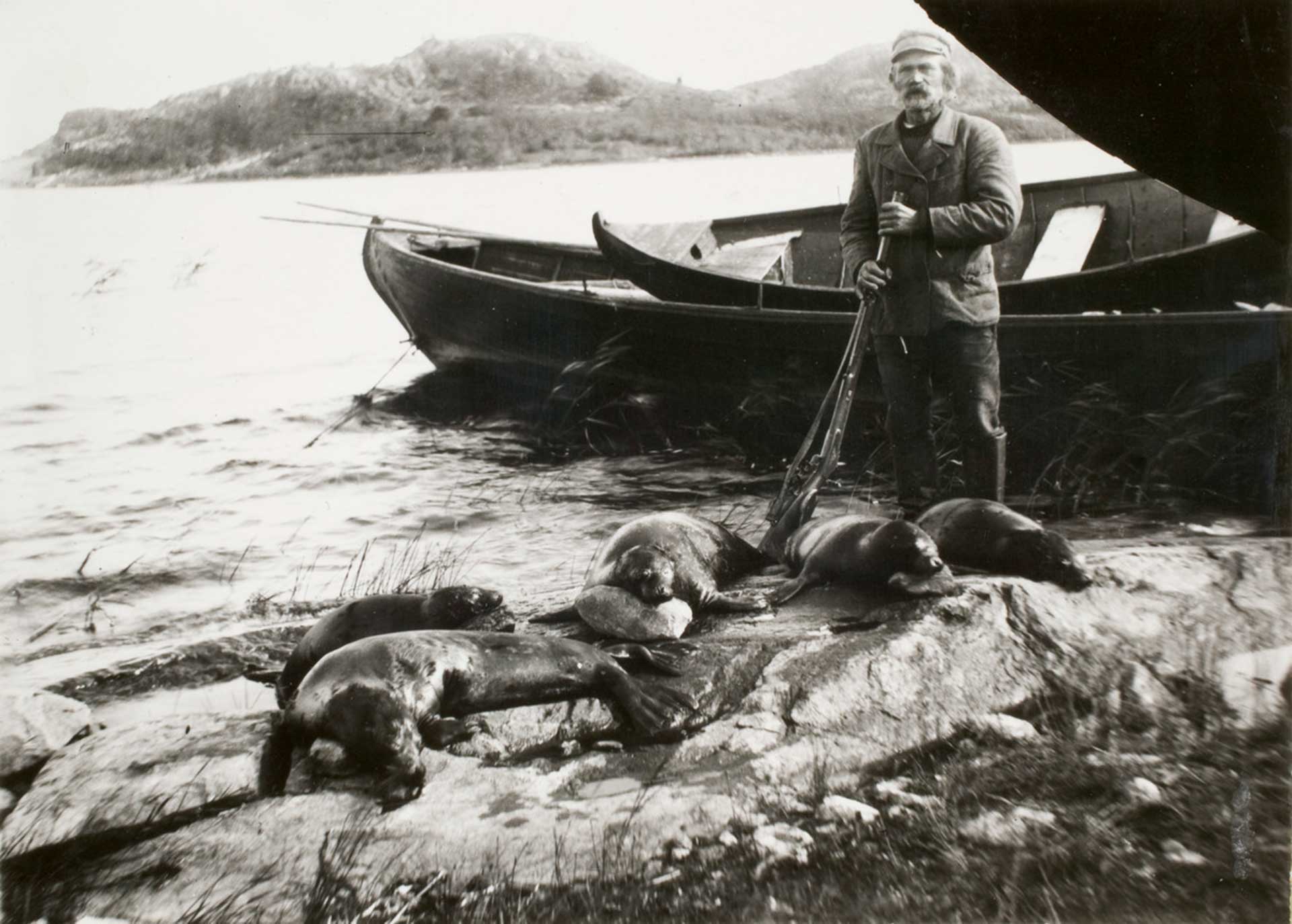
On the open waters of Lake Ladoga, there still existed in the early 20th century a distinctive fishing culture that combined the fishermen's livelihood, ancient beliefs and an exceptional knowledge of nature. The Ladoga ringed seal, the Ladoga seal (Pusa hispida ladogensis), was an important supplementary livelihood for many coastal fishermen during the time of year when fishing was at its quietest.
The Ladoga seal was a close relative of the Saimaa ringed seal, but larger. It could grow up to a metre and a half long and weigh up to 80 kilos in the late summer. In summer, the seals liked to stay on the outermost islands and rocky islets, and in winter on vast ice fields, where they built their snowy lairs near cracks in the ice. The breathing hole beneath the lair provided access to the water and good fishing grounds.
In autumn, ringed seals were hunted using a method called coaxing. The hunter would dress in black clothes and imitate the sounds and movements of a seal on the shore rocks. The seal's good hearing and weaker eyesight meant that the animal could become interested in the call and approach the caller. The actual shooter waited in hiding behind rocks or shoreline bushes.
Coaxing involved old beliefs and rituals. The spirits of the forest and water were placated before hunting. A small gift—such as a mitten or a piece of cloth—was thrown onto the land to ensure good hunting luck. Shooting the head of a snake was also believed to bring success in the autumn hunt.
In calm weather, ringed seals could hear the caller from several kilometres away. When the animal approached closely enough, a rifleman with a steady hand shot it. The catch, which had sunk to the bottom, was hauled up using a seal hook or a barbed spear.
The dangerous fishing of spring ice
However, the main ringed seal hunt took place in spring, when the ice on Lake Ladoga began to break up and move. At that time, the ringed seals would climb onto the edges of the ice cracks to bask in the sun and moult.
Hunting expeditions lasted for months at a time. They carried ammunition, spears, hooks, barrels of grease, and a light boat on sledges or in boats. When the ice broke up into floes, the hunters travelled in sea boats between the archipelago and the drifting ice fields.
Patience and skill were emphasised in the spring hunt. The ringed seal was always approached from downwind. The hunter would crawl slowly across the ice field, stopping whenever the animal raised its head. Often the best cover was found at the edge of an ice ridge or crack. If the shot hit the head, the catch remained on the ice. A poorer hit usually meant the animal would disappear into the depths of Lake Ladoga.
Several ringed seals may have been shot before the men set about hauling the catch from the ice-cold water. Lake Ladoga in spring was unforgiving, however. The ice could break up rapidly in storms, and many fishermen spent cold nights in boats under the protection of canvas sails.
Nets, holes in the ice and ringed seal hooks
Not all ringed seal hunting was based on shooting. Net fishing was also known on the Karelian Isthmus. The nets were set around stones onto which the ringed seals climbed to rest. At the opportune moment, the poles of the net were raised to the surface and the animal was trapped.
In winter, fishing from open holes in the ice was also used. Keen-nosed dogs searched for the ringed seals' breathing holes, all of which were blocked except for one. When the seal surfaced to breathe, it was killed with a spear or a seal hook.
The ringed seal hook and ringed seal spear belonged to the equipment of every experienced seal hunter. They were simple yet effective tools used to lift the catch from under the ice into a boat or onto the shore.
The fat was the most valuable haul
Although ringed seal meat was not particularly valued, the blubber was highly sought-after. A single ringed seal could yield an average of around ten kilograms of fat, and even more from large specimens. The fat was used to make ointments for treating shoes, leather, and even aching joints.
The ringed seal's pelt was also valuable. It was used to make waterproof footwear, rucksacks and fur coats. At the beginning of the 20th century, a single ringed seal could fetch around 15 markkaa – a considerable sum as supplementary income during the spring mud season.
Seal hunting was never the most important livelihood on the shores of Lake Ladoga, but it supplemented the fishermen's income during a time when other forms of fishing were difficult. At the same time, it created its own special culture: the silent spring ice, drifting ice floes, dangerous crevices and sharp-eyed hunters were part of Ladoga's spring for centuries.


