Life on a ration card – sense and taste the era of scarcity
Käkisalmi Museum's summer exhibition, "Savour and Taste the Hard Times", takes visitors on a time travel experience to the era of scarcity and traditional Karelian food. In the hardship-era recipes, simple ingredients are transformed into nutritious everyday delicacies that tell a story of survival, ingenuity and a strong food tradition. The exhibition opened to the public on 1 June and will be on display until 31 August 2025.
Operating behind the scenes of the exhibition this summer is the museum's evacuee kitchen, which brings history to life through tasting. Authentic morsels based on period recipes are prepared for exhibition visitors. At the Käkisalmi Museum, visitors can taste dishes such as nettle and potato mash, lingonberry and carrot kissel, barley breadlets and hardship-era oat cake.

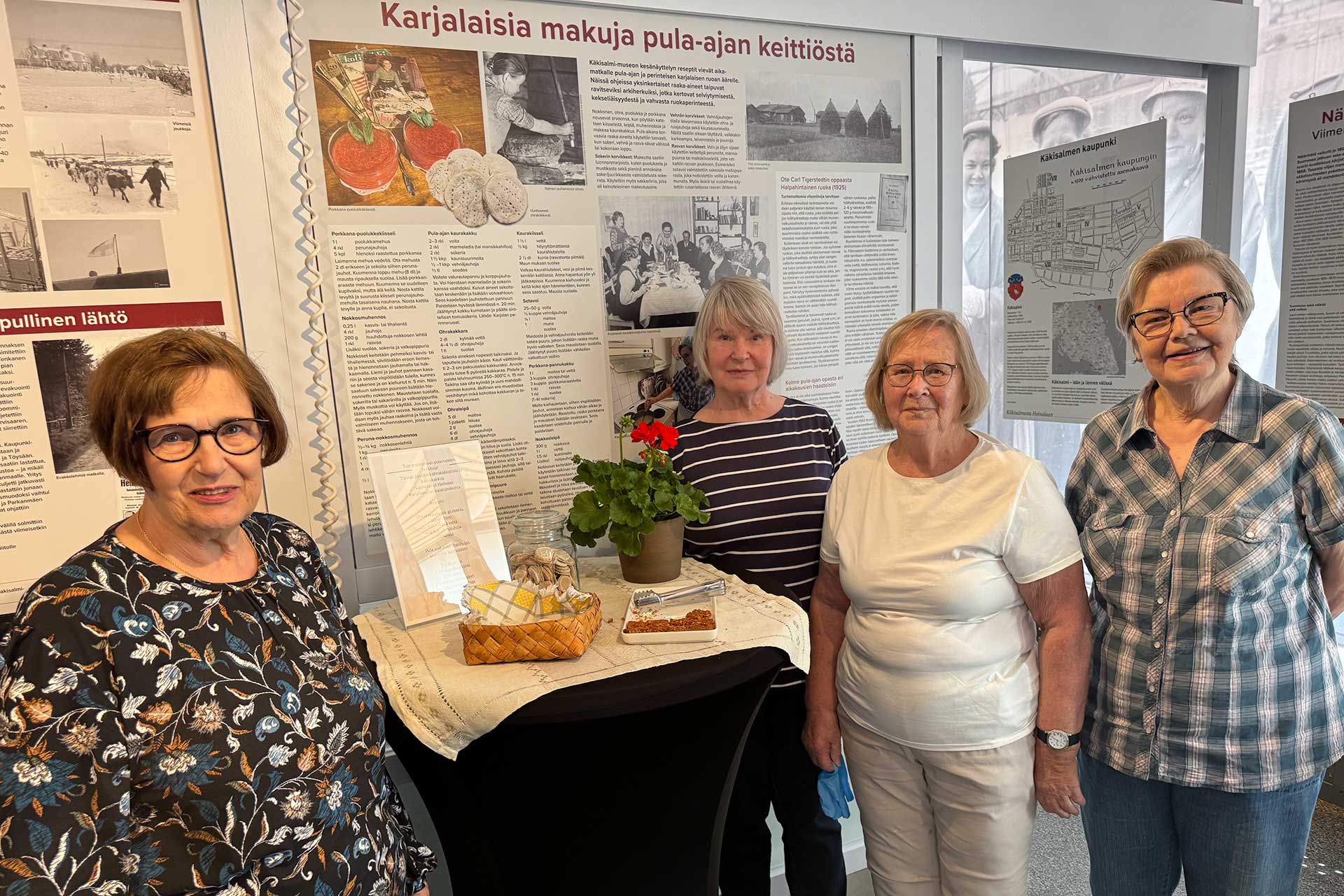
The women of Heinola Karelian Society's evacuation kitchen Liisa Vehkasalo (left), Marketta Ylönen, Raija Tiira and Aino Surakka at the summer exhibition tasting hardship-era food, Kaisa Kaikkonen is missing from the photo.
Nettle, barley, lingonberry and carrot come into their own when kissels, breads, stews and sweet oat cake are laid on the table. During times of scarcity, substitute ingredients were used creatively when sugar, wheat and fat were in short supply or ran out completely.
Sugar substitutes: Sweetness was obtained from wild berries, such as lingonberries and blueberries, and in small amounts from sugar made from sugar beet. Saccharin, which was an artificial sweetener, was also used.
Wheat alternatives: Barley and rye flour as well as oat groats were used in baking instead of wheat flour.
These were used to make filling, albeit coarser, pastries and porridges.
Fat substitutes: Instead of butter and oil, boiled potatoes, semolina porridge or milk puddings were used, which were beaten into the fat. For example, ‘war butter’ was made from thick milk porridge, which was thinned with butter and egg. Lard or salted meat was also used as a source of fat in cooking.
Carrot and lingonberry kissel
1 l lingonberry juice
4 tbsp potato starch
5 finely grated carrots
Dilute the juice with water. Take 2 dl of the juice separately and mix the potato flour into it. Heat the rest of the juice (8 dl) and season with a pinch of salt. Add the grated carrot to the juice.
Reheat it until it bubbles, but do not bring it to the boil. Remove the saucepan from the hob and thicken the kissel with potato flour mixed with juice, pouring it in a steady stream.
Place the saucepan on the hob and let it bubble – do not stir.
 Nettle mash
0.25 l of vegetable or meat stock
4 tbsp flour
200 g rinsed nettle leaves
1 tbsp fat
Also salt, sugar and white pepper
Boil the nettles in vegetable or meat stock until tender, strain them to remove the stock, and chop them finely by grinding or mincing. The stock and flour are placed in a saucepan and the mixture is whisked over the heat until it thickens and has boiled for about 5 minutes. The finely chopped nettles are then added to the thick porridge. Season with salt, sugar or saccharin and white pepper. Nutmeg may also be used. If available, add a little fat at the end. Nettles can also be ground whilst raw and added only to the finished stew, which should be made thick.
Potato and nettle stew
0.5–0.75 kg nettle leaves
1 kg of potatoes
1 tbsp fat
Brown 1 onion
4 tbsp barley flakes or crushed barley groats
0.5 l skimmed milk salt
Bring the nettle leaves to the boil and chop them coarsely. Peel the potatoes and cut them into slices. Brown the onion in fat. Layer the potato slices, chopped leaves and browned onion in a greased ovenproof dish, finishing with a layer of potato slices. Sprinkle the flakes over the layer of leaves. Finally, pour the milk into the dish. Bake for 45–60 minutes.
Oatcake from the period of scarcity
2–3 tbsp butter
2 tbsp marmalade (or strawberry jam)
2 tbsp sugar
1 ½ cups of oat groats
½–1 kkp wheat flour
½ tsp bicarbonate of soda
Grease a cast-iron pan and coat it with breadcrumbs. The butter is beaten into a foam with the marmalade and sugar. The dry ingredients are mixed together and added to the butter foam. The mixture is poured into the floured pan. Bake in a good heat for about 20 minutes. The cooled cake is turned out and dusted with icing sugar. Source: Karelian traditional dishes.

Barley cake
2 dl cold water
4–4 ½ dl barley flour
1 tsp salt
Quickly mix the ingredients into a dough. Knead with floured hands. Roll out immediately into a sheet 2–3 cm thick. The mixture makes 6 round cakes. Prick the cakes with a fork and bake in a conventional oven at 250–300°C for approx. 15 mins. The dough should be cold and the oven as hot as possible; the sudden temperature difference creates steam, which raises the cakes and makes them crumbly.
Barley bread
500 ml of milk
1 packet of yeast
2 tsp salt
6 dl barley flour
400 ml plain flour
Warm the milk to hand temperature. Stir in the yeast and salt. Add the barley flour while stirring vigorously for about 40 minutes. Then work the wheat flour into the dough. Knead the dough and shape it into 2–3 loaves. Use flour when shaping, as the dough is quite soft. Prove on a baking tray.
20 mins. Prick the bread all over with a fork.
Barley groats oven porridge
2 cups of pearl barley
1 ½ l water-diluted milk or water
½ tsp salt
The rinsed groats are mixed with the broth and salt in a stone pot and put in the oven to bake. Once the groats have swelled, the porridge is stirred so that the groats do not stick to the bottom.

Oat kissel
1 ½ l of water
½ kg of non-steamed
oats
2 ½ dl soured milk (fat-free buttermilk) Salt to taste
Whisk together the oat flakes, water and buttermilk in a saucepan. Leave to sour overnight in the fridge. Bring to the boil and simmer, stirring constantly, until the mixture thickens. Season with salt.
Sotavoi
25–50 g of butter
½ cup of plain flour
0.25 l milk
1 egg
salt
A thick porridge is boiled from milk and wheat flour, to which a raw egg is added while whisking well. The mixture is seasoned with salt. The cooled porridge is added gradually to whipped butter.
Carrot pancake
1 l of milk or water 3 cups of barley flour
3 cups of grated carrot
1 tbsp fat
1 tbsp salt
(1 tbsp sugar)
The milk is brought to the boil, the flour is whisked in, allowed to boil for a little while and cooled. Grated, raw carrot and seasonings are added to the mixture. The mixture is poured into a greased pan and baked.
Nettle bread
300 g stinging nettles
1 l water
1.5 tbsp cumin seeds
Also rye flour
The nettles are boiled until soft. The boiling water is used as the liquid for the dough. The boiled nettles are minced either in a mill or a chopper and added to the liquid.
The spices and yeast are added and the dough is kneaded to a normal consistency, shaped into round, flat loaves which, after rising, are baked in a normal oven temperature.