The railway brought industry and tourists to Lake Ladoga
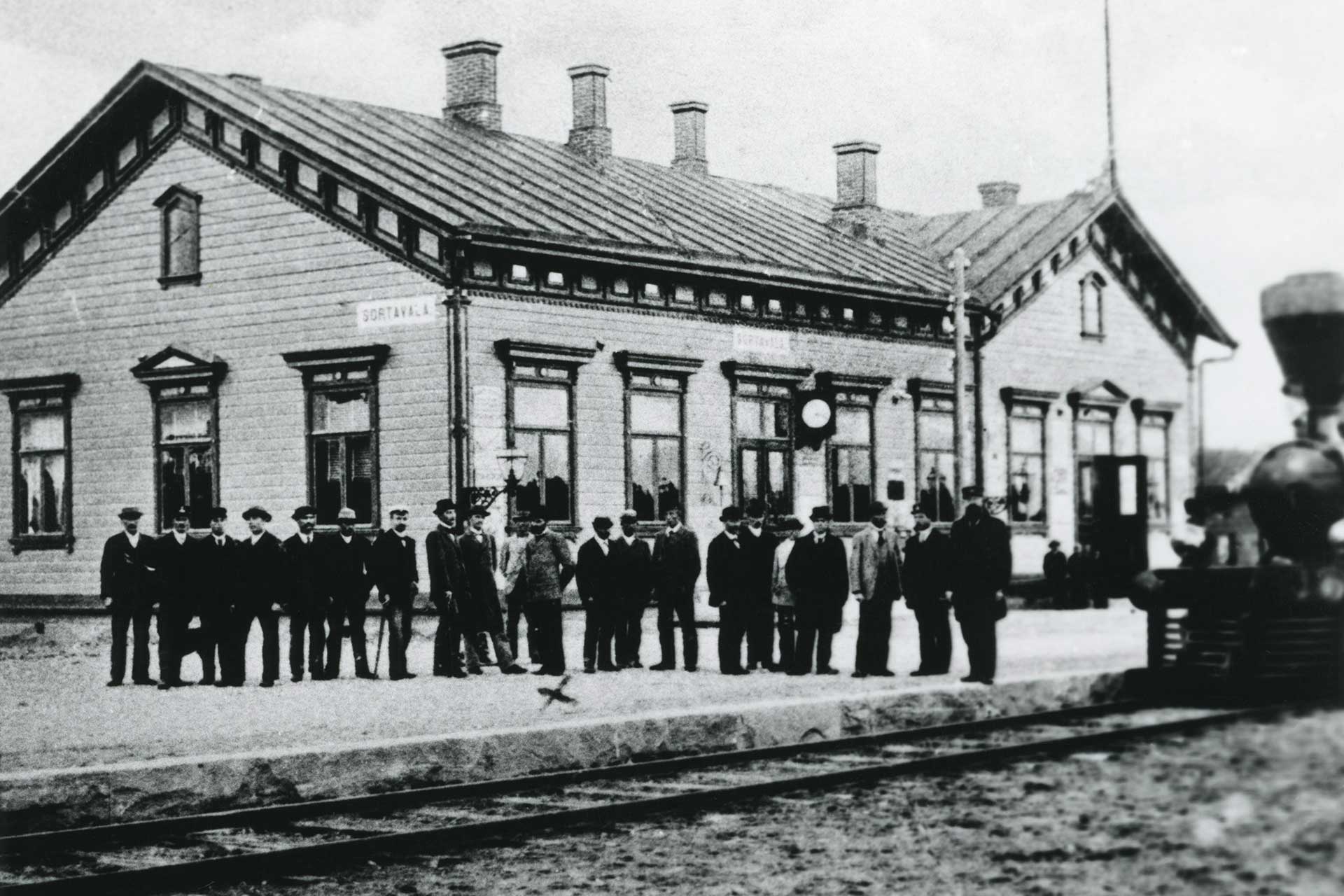
Before the wars, the Karelian rail network was the densest in Finland. The main lines built during the autonomous period ran between Riihimäki and St Petersburg, and between Vyborg and Joensuu. Karelia also had many branch lines and spurs.
There were numerous reasons for the construction of the railways, which were related to the economy, tourism and national defence, among other things.
The railway between Riihimäki and St Petersburg was opened in 1870. Its length was 371 kilometres. Over 10,000 people took part in building the railway. Up to 20 percent of the builders of the railway, which was constructed during the great years of famine, may have perished in a single year.
The approximately 340-kilometre-long Karelia Railway from Vyborg via Antrea and Sortavala to Joensuu was opened in 1894. The section between Vyborg and Antrea had been opened in 1892, and the section between Antrea and Sortavala a year later. During the planning stage, there were several alternatives for the railway route – one of them would have run via Kexholm. In 1892, a branch line from Antrea to Imatra was completed.
The Karelian railway was extended from Joensuu to Lieksa in 1910 and to Nurmes the following year. The railway between Vuokatti and Nurmes was completed in 1929. The Savonia railway had been built from Kajaani to Kontiomäki junction station in 1924.
Käkisalmi only got its own rail connection in 1917, which slowed down the town's development. Before that, Käkisalmi's rail traffic went via Hiitola, which was on the Vyborg–Joensuu railway.
The railway network was also expanded north of Lake Ladoga in Border Karelia, but development was slow. The railway from Pitkäranta to Uuksu in Salmi was not completed until 1934. In addition to the municipalities, it had been demanded especially by the forestry and mining industries.
The most important junction station on the Karelia Railway was Elisenvaara, located in the parish of Kurkijoki. From there, the railway went to Vyborg, Joensuu, Savonlinna and Lappeenranta. Junction stations with three directions were Antrea, Hiitola, Tyrisevä, Matkaselkä and Jänisjärvi.
The strong growth of Sortavala had begun around the 1890s with the railway and the seminary. From Sortavala, the rail distances are 460 kilometres to Helsinki, 264 to St Petersburg and 133 to Joensuu.
Initially, two train services ran in both directions between Viborg and Sortavala per day. The journey time was around seven hours. The journey to Joensuu took about five hours.
The completion of the Karelian railway changed Sortavala and Ladoga Karelia fundamentally. The region's growth continued strongly, the economy grew and industrialisation began robustly. The railway offered new opportunities for both exports and imports, as fast trains replaced slow water transport. One consequence of the completion of the railway was the establishment of numerous dairies and an increase in butter exports. It also changed Karelian agriculture. Cultural influences also travelled along the railway, especially to the Sortavala region, and the railway bound Ladoga Karelia tightly to the rest of Finland.
In Ladoga Karelia, the importance of train and ship connections for tourism was well recognised. As early as the late 19th century, many Russians visited Sortavala on their way to Valaam. From Finland, tourists were drawn not only by Valaam, but also by Vakkosalmi Park and Mount Kuhavuori, as well as the Ladoga archipelago. For a long time, Sortavala was also the gateway to the Kalevala song lands.
Following independence, the importance of tourism only grew, and both hotels and restaurants were established in the city.
The use of the Karelian railways ended on 22 September 1944, when Finland's last evacuation train departed from Sortavala station.


