Ruskeala marble in newspapers
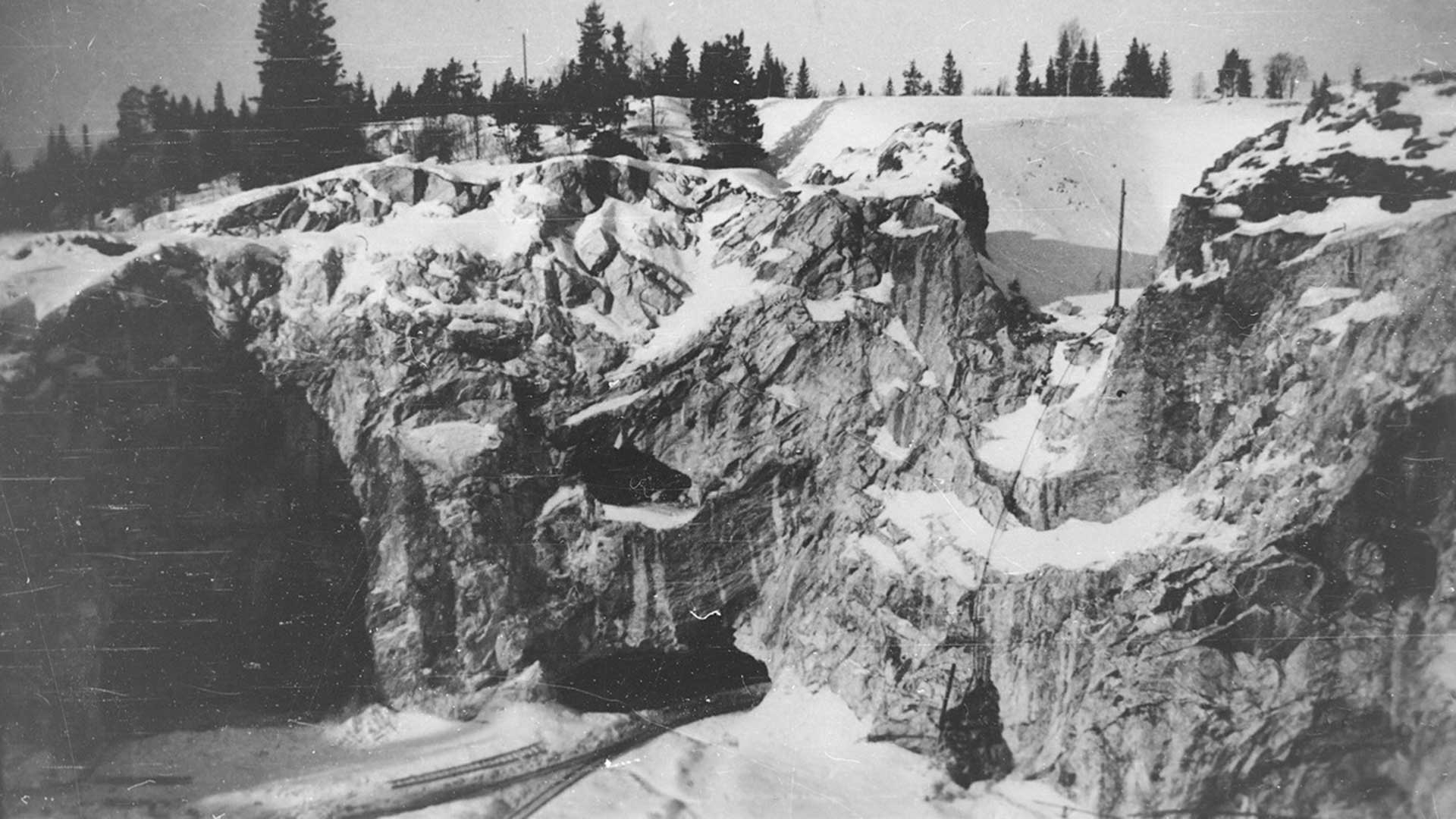
Forests and waters were the most important natural resources of the Province of Vyborg and the Lake Ladoga region, but minerals were also of great significance.
From Ladoga Karelia, at the Ruskeala quarry, stone was transported to St Petersburg for significant buildings from the mid-18th century. Ruskeala marble is used at least in St Isaac's Cathedral, the Winter Palace and the Hermitage. In Helsinki, the stone has been used in the former Yleisradio office building on the edge of Kasarmintori and in the Savings Bank building. In addition to Ruskeala, the shores of Lake Ladoga held other minerals. Granite was quarried in Antrea. Copper and tin were quarried in Pitkäranta, near the shore of Lake Ladoga. By water, heavy minerals were easy to transport.
Ruskeala marble was also known abroad. It was sent to the Paris World Fair in 1867.
Marble quarrying began in 1764. In 1792, the stone was noted as being ”white, loosely textured soapstone, occasionally shimmering with a reddish hue, as well as being black-veined and speckled”. Quarrying ended in the early 1980s. Today, the mine is a popular tourist attraction.
Here are newspaper articles about Ruskeala marble from the late 19th century.
Suomenlehti 3 February 1874
In 1761 the first foundation was laid for St Isaac's Cathedral, which after many vicissitudes was completed in 1801, but disappeared, and construction began anew in 1819, it was consecrated in 1859, although it was only truly completed in 1864; on the outside it is faced with Ruskeala marble and the granite stone used for it is from Finland.
Tapio 21.3.1874
Old memories from Savo-Karelia.
In 1792, the Swedish government sent a capable and experienced man, Mr Rinman, to the ”most distant provinces of the Swedish realm”, to Savonia and Karelia, to investigate the matters there....
Rinman also mentions marble, which is brought from Ruskeala in Russian Karelia, that it is white, loose-grained talcose stone, occasionally with a reddish shimmer, as well as black-streaked and speckled. When Rinman visited the marble quarry, stones were being quarried there at that time, 4 to 5 cubits long and 2 to 3 cubits wide, for a new church in St Petersburg. The stones were hauled by horses to the loading place, three leagues from the quarry, on the shore of Lake Ladoga, and from there by sea to St Petersburg.
Central Finland 17.10.1874
Ruskeala marble quarry.
As Saint Isaac's Cathedral in Saint Petersburg is to be repaired and new marble stone is needed for the purpose from Ruskeala, from whence it was previously taken for the construction of the said cathedral, it is reported that the Russian Ministry of the Interior has asked the Finnish Senate that the said marble quarry, which is in the possession of the Finnish state, either be leased for 12 years or ceded to Russia in perpetuity. The matter is currently under discussion in the Senate. (U. S.)
Finnish Official Gazette 30.10.1877
- T. states that the Imperial Senate has granted sculptor Botto the right to take marble from the Ruskeala marble quarry for the repair of St Isaac's Cathedral in St Petersburg until the end of the year 1886, a total of 60,000 square arshins, for each square arshin of which Mr Botto will pay 50 kopecks to the Finnish Crown, in whose possession the said marble quarry is.
Ilmarinen 6 April 1886
The municipality of Ruskeala has applied to restart the marble quarrying work as relief work, but the provincial government has rejected the application on the basis of the reasons presented by the relevant local crown bailiff.
Finnish Official Gazette 12.1.1891
As is well known, Finnish marble (from the parish of Ruskeala to the north of Lake Ladoga) was used for St Petersburg's St Isaac's Cathedral, as well as several other magnificent buildings in the said capital. For decades, however, St Isaac's Cathedral has remained unfinished due to a lack of the building material in question. As early as the early 1870s, the Senate was asked whether marble could be obtained from Finland to complete the building, and after a reply had been given, the Russian authorities made a procurement contract with a couple of contractors. One of them did not even begin any work here in Finland, while the other, after quarrying and sawing marble in Ruskeala for a while, declared that this marble was not suitable for the purpose after all. Italian marble was subsequently used for the completion work of St Isaac's Cathedral, but the colour of this new building material differed to such an extent from the darker Finnish marble previously used that the entire appearance of the world-famous cathedral was in danger of being disfigured. The work was therefore suspended, but now the completion of St Isaac's Cathedral has once again become a topical issue. The Russian Minister of the Interior has therefore asked the Finnish Senate whether marble similar in appearance to that from which St Isaac's Cathedral was built could be obtained from Ruskeala or somewhere else in Finland, and whether one institution or another could, in exchange for a stated price, take charge of procuring such marble for the purpose in question. In view of this, as Finl. reports, the Senate has ordered the Industrial Board to send Mining Intendent C. P. Solitander to Ruskeala to investigate the extent to which marble is available there, and to take and polish a few blocks of marble as samples, after which the Industrial Board must promptly issue an opinion on the matter.
Karjalatar 26.7.1892
Marble analysis.
Mill engineer at the Industry Board A. F. Tigerstedt left on the 20th of the current month, U. S. reports, to Ruskeala to examine the marble mountains there. The purpose of his investigation is to find out to what extent the marble layers are intact and otherwise of such a substance that they do not crumble under the influence of the weather. This investigation will take place here in a manner not previously tested.
As is known, our mountains are generally full of surface cracks and fissures. These fractures, which are often so dense that it is not easy to obtain larger intact blocks from the surface of our mountains—such as those needed when preparing more expensive construction work, pedestals for monuments, and similar things—have been created in our mountains over the course of years by the action of frozen water. Often, however, the aforementioned cracks do not extend very deeply, but one encounters intact stone further down. The marble mountains of Ruskeala are also very much fractured on the surface, even to the extent that the extraction of marble, which was already well underway there a few decades ago for export to Russia, subsequently ceased so completely that nowadays only a certain amount of lime is burnt from the marble flakes piled up at the former quarry sites. For marble is a type of limestone, but much finer-grained, harder, and more suitable for construction work than the aforementioned stone.
Finding out whether rock is sounder deeper down than on the surface has hitherto been done by using drilling and gunpowder. Pushing deeper in this way is, however, both time-consuming and costly work. It is now intended to obtain this information by another means. In rock mines where ores are broken, it sometimes happens that the ore runs out completely; in every direction there is only useless rock to be met with. This is what happened at the Orijärvi copper mine, the work of which therefore had to be suspended for decades, and the Pitkäranta copper mine fared equally unluckily. Nevertheless, the diamond drill saved the future of the mine. This tool is a machine-driven drill with which one can grind holes hundreds of metres long into the rock. Diamonds are embedded in the tip of the drill, which withstand the wear of the stone better than steel and, as they rub against it, quickly eat their way through the stone. The diamond drill is hollow in the middle, so that a core of rock remains inside it, which the drill brings up to view. From this core it can then be seen what and what kind of substance the rock strata are through which the drill has penetrated. It is now hoped that from the diamond drill's core in Ruskeala it can be seen whether, and how deep down, sound and otherwise suitable marble exists in the rocks there.
The idea for a thorough investigation of the marble mountains of Ruskeala arose from an official inquiry that arrived here from St. Petersburg the autumn before last, asking whether marble needed for the repair of St. Isaac's Cathedral could be obtained from Finland. In addition to this need, it was believed that there were other demands for marble in Russia. Since the Karelian railway currently under construction will pass close to the Ruskeala quarries, the local marble mountains, provided that larger, unbroken blocks can be obtained from them, would gain a favourable transport route to even more distant markets.
Kotkan Sanomat 10.7.1894
— Joining the inspection trip to the Ruskeala marble quarries, along with Senator Ignatius and reporting secretary Fellman, was Mining Board Intendent Solitander. During the trip, an attempt will likely be made, among other things, to ascertain whether building some kind of trackway to transport marble from Ruskeala would be worthwhile. — Wiip.
Kotkan Sanomat 10.7.1894
Ruskeala marble quarry.
The Board of Industry has informed the Senate that the quarrying of marble at the Ruskeala marble quarry—which, due to long and expensive transport over three miles to the shore of Lake Ladoga, had to be stopped because marble can be obtained much cheaper from other parts of Europe on account of good transport facilities—could now, as the Karelian railway is nearing completion, be advantageously resumed, and it might perhaps become a permanent industry; therefore, the Board of Industry has proposed that the state, as the owner of the marble mountains, should as soon as possible have a survey carried out and a cost estimate made for a branch line to the mountain, and that the state should build the said branch line at its own expense in the event that a private individual or company offered a guarantee that the work would be continued on a larger scale. In consequence of this, the Senate has ordered the General Directorate of Roads and Waterways to investigate the construction of a branch line from the Karelian railway to the vicinity of the marble quarry and to draw up a cost estimate for a simple branch line. — P:ti.
Lake Ladoga 4.10.1893
Stairs are currently being built for Sortavala station from Ruskeala marble. Stairs are likewise being built from the marble at Matkaselkä station, where the plinth of the entire main building is also made of marble.
Ladoga 11.7.1894
— Branch line to the Ruskeala marble quarry. The Board of Industry has proposed to the Senate that the quarrying of marble at the Ruskeala marble quarry—which could not be carried out because transporting the marble by land to the shore of Lake Ladoga, a distance of more than three leagues, was unviable since marble can be obtained much more cheaply from other parts of Europe via improved transport routes—now that the Karelian Railway is nearing completion, could evidently be resumed with greater success and become a profitable industry. For this reason, the Board of Industry has proposed that the state, as the owner of the marble quarry, as soon as possible and while work on the said railway is still ongoing, should have a survey and cost estimate made for a branch line from the railway to the mountain, and that the state should construct the said branch line at its own expense in the event that a private individual or company guarantees that quarrying will be carried out continuously and on a larger scale. In consequence of this, the Senate has ordered the Main Directorate of Roads and Waterways to survey and investigate a branch line from the Karelian Railway to the immediate vicinity of the marble quarry and to draw up a cost estimate for the construction of a simple working railway.


