Memories of the past
Leena Railimo-Saares – continuity and practicality
Throughout her life, Leena Railimo-Saares has received and acquired several Kalevala jewellery pieces, each of which is connected to a specific moment or gift. One of her most significant treasures is the Kiviriipus pendant, the lace-like frame of which originates from a silver annular brooch found in the Inari region. The pendant was made for the Rovaniemi Summer Festival in the 1970s.
She also has two pieces of jewellery from the Prime Time collection: the Suomuhauki (Scale Pike), designed by silversmith Kaisaleena Mäkelä, which she acquired herself, and the Kalevankarhu (Kalevala Bear), which she received as a gift from the Kalevala Women of Espoo at the association's 20th anniversary celebration. Both are fascinating for the power of their ancient animal motifs and their connection to Finnish mythology.

Representing the lineage's chain, meanwhile, is the Suotniemi brooch, the prototype of which dates from the 13th century from Suotniemi in Käkisalmi. The heart palmettes of the jewellery symbolise the kingdom of heaven and the eternal cycle. The brooch belonged to Railimo-Saares's mother, and through it is conveyed the mother's cherished idea of the continuity of the family.
Representing more modern design is the Plisé piece of jewellery, a pendant inspired by skirt hems designed by Marja Suna. Railimo-Saares bought it after returning from South Sudan from a nine-month work assignment – a tangible reminder of the phases of her career and her return home.
Railimo-Saares describes herself as a ”poor jewellery wearer” due to her long career as a nurse. For her, jewellery is part of her identity and cultural heritage. She says she always chooses her jewellery according to the occasion. Her mother was a Kalevala Woman, and it is important for Railimo-Saares to pass the heritage on; her jewellery will eventually go to her daughter Maiju and her granddaughter Eden. An international life has not taken away her northern roots – she bought her son-in-law an English translation of the Kalevala and gives Kalevala jewellery as gifts because to her they signify love, family and the preservation of Finnish culture.
Henna Paasonen – memories of a grandmother and youthful love
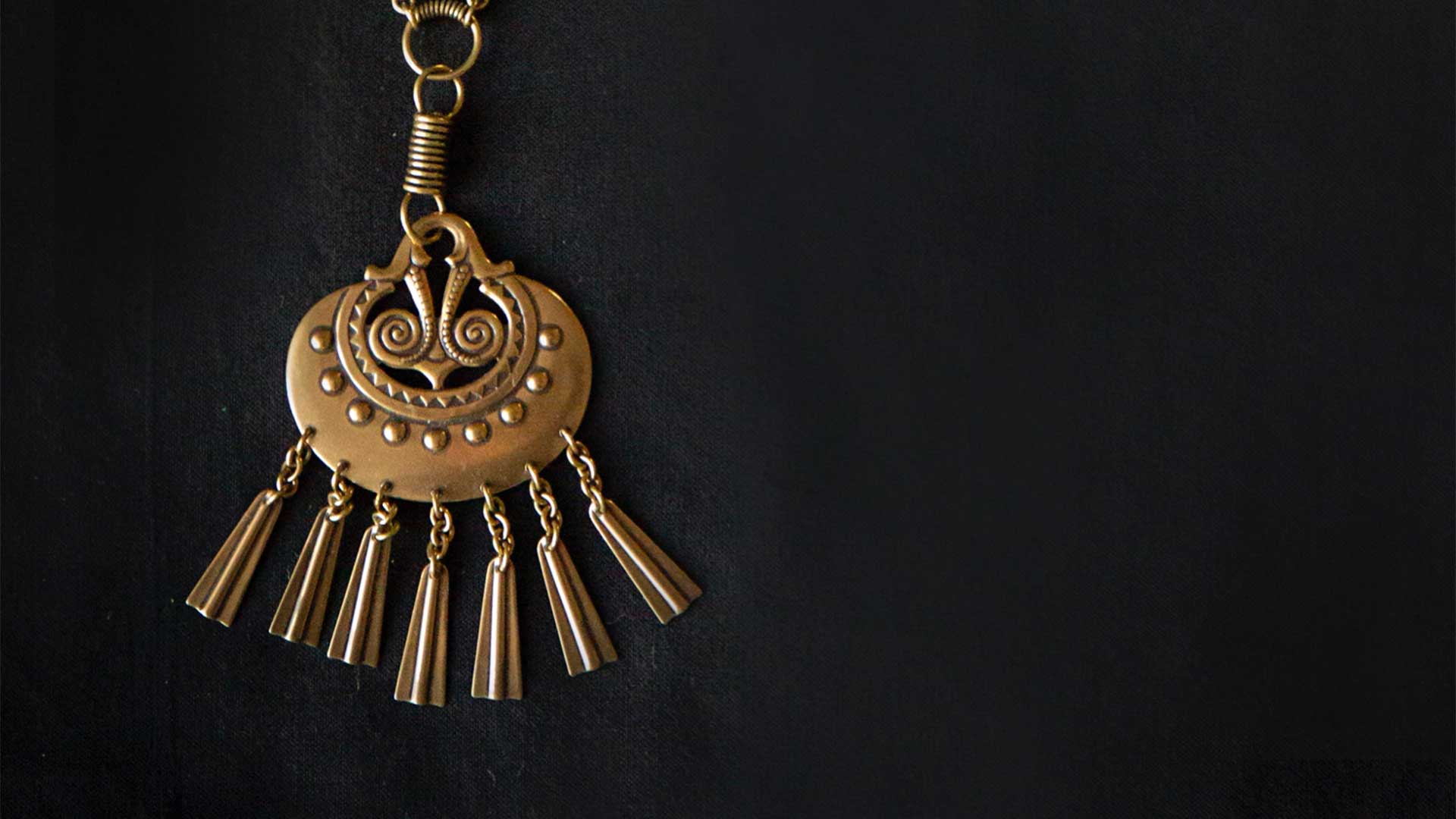
Henna Paasonen's jewellery memories are closely linked with her grandmother, her youth and her student years. Her most cherished piece of jewellery is Kuutar, an iconic pendant designed by Germund Paaer, in which ancient lunar motifs are combined with Viking Age spirals. Paasonen received it from her grandmother Maire, a Karelian woman who raised her family amidst wall hangings, lace doilies and a garden. Her grandmother took special care of Paasonen, who was a child of divorce, and was proud of her studies. The Kuutar pendant reminds her of the care and love that her grandmother gave her.

The other piece of jewellery, Apple, brings to mind youthful love. The bronze and ceramic pendant was a gift from Jouni, associated with both intense feelings and a sense of wistfulness. Although the relationship ended, Paasonen has kept the jewellery and the letter given with the gift – as a memory of a time when love was all-consuming for the first time.
On the threshold of adulthood, she also bought herself some jewellery. Kehrääjä (Spinner), a spectrolite pendant from a collection designed by Tony Granholm, was a reward to herself for work in Hämeenlinna in 2005. The delicate shape of the piece suited her batik dresses and brought joy to her everyday life.
During her studies in the 1990s, Paasonen bought Kuusamo axe earrings, which are based on an ancient silver hoard. They were connected to cultural studies student circles, the popularity of the band Värttinä, and the freedom of youth, when Henna dyed her hair and second-hand clothes completed her style.
In Paasonen's jewellery, personal memories and cultural meanings intertwine. Every pendant and earring carries a story – the security given by a grandmother, the love of youth, the achievements of adulthood and the sense of community from student years.
Marja-Leena Karinen – aesthetics and chains of families
Marja-Leena Karinen's jewellery memories are strongly intertwined with her mother and mother-in-law. For her, aesthetics and the story are important in jewellery, but so is the fact that they are passed down from generation to generation.
The Setu necklace comes from her mother. Her mother, who appreciated a keen aesthetic eye, wore jewellery sparingly, but each piece carried weight. Karinen feels she has inherited this sense of aesthetics from the atmosphere of her childhood home.

Meanwhile, the Viking Age brooch came to her from her mother-in-law, with whom she had a warm and respectful relationship. The brooch is a practical fastener for a cardigan, but also a symbol of the appreciation shown by her mother-in-law.
Mother also gave her a pendant, a replica of a Viking Age piece of jewellery found in Palviala, Karkku. According to Karinen, it is her ”treasure jewellery” because it speaks of her mother's love and commitment.
Inherited from her mother is also a horseshoe brooch, based on findings from Maaria's Virusmäki. Mother fastened her scarf with it, and Karinen does the same – a small, everyday gesture that continues the chain of generations.
Representing modern design, the Spirit of Fire jewellery was given as a gift by her husband. Karinen chose them herself, and their symbolism is connected to her star sign, Aries, and the fire god Mars.


